Talk to us Risks to Watch

Core of Endpoint Security: Just-in-Time Elevation | Elimination of Standing Privileges

Key Takeaways

  • Standing privileges create persistent risk by leaving administrative access available even when it is not required.
  • Just-in-Time (JIT) elevation provides elevated access only when a specific task requires it and for a defined period.
  • Eliminating standing privileges helps reduce the attack surface associated with compromised users, endpoints and identities.
  • Least privilege becomes operational when users receive only the permissions needed to complete an authorized task.
  • Application-specific elevation can allow approved applications to run with elevated rights without granting users permanent administrator access.
  • Policy-based controls can determine who receives elevation, which applications can be elevated, under what conditions and for how long.
  • Workflow-driven elevation helps organizations balance security requirements with employee and IT support productivity.
  • Continuous monitoring and audit trails provide visibility into elevated activities and support investigation and compliance.
  • ARCON | EPM combines JIT-oriented privilege management with PEDM, application controls, workflows, FIM, monitoring and centralized governance.
  • The core objective is simple: keep users at standard privilege by default and elevate access only when legitimate business requirements demand it.

Modern enterprises operate across thousands of endpoints, applications, users and workloads. While this distributed environment enables productivity, it also creates opportunities for attackers to exploit excessive or persistent privileges.

The traditional approach of assigning administrator rights to users for convenience creates a fundamental security problem: privileges that are required for a specific task often remain active long after the task is completed.

Just-in-Time (JIT) elevation changes this model. Instead of giving users permanent administrative rights, JIT provides the required level of privilege only when it is needed, for the specific task, and for a defined period. Once the activity is completed, elevated access can be revoked. For endpoint security, this means moving from standing privilege to controlled on demand privilege supporting Zero Trust and the principle of least privilege.

What Is Just-in-Time Privilege Elevation?

Just-in-Time privilege elevation is an access-control approach in which a standard user receives elevated rights temporarily to perform an authorized task.

Consider an employee who needs administrator-level access to install an approved application, troubleshoot a system component or perform a configuration change. Under a traditional model, the employee may receive local administrator rights that remain available continuously.

With JIT elevation, the user remains a standard user by default. When an approved task requires additional permission, an elevation request can be initiated according to predefined rules or workflows. The required privilege is granted temporarily and can subsequently be removed.

This creates a simple security principle: No permanent privilege unless required.

Why Eliminate Standing Privileges?

Standing privileges create a persistent attack surface. If an endpoint or identity with administrative rights is compromised, those privileges may provide an attacker with additional opportunities to install malicious software, modify configurations, access sensitive resources, or move toward other systems.

The challenge becomes greater when organizations manage large and distributed endpoint estates. Users change roles, applications change, projects end, and devices are continuously added or removed. Permanent administrative rights can therefore become difficult to govern consistently.

Eliminating standing privileges helps organizations:

  • Reduce unnecessary administrative access
  • Limit the exposure created by compromised endpoints or identities
  • Enforce least-privilege access
  • Control access to business-critical applications
  • Create greater visibility into elevated activities
  • Establish a more Zero Trust-oriented endpoint security model

JIT therefore addresses not only who can access a resource, but also when and for how long elevated access should exist.

Types of Just-in-Time (JIT) Endpoint Access

Organizations can implement JIT at endpoints through different mechanisms depending on the task and security requirements.

Temporary Privilege Elevation: A user can receive elevated rights for a defined task without becoming a permanent administrator. This is particularly relevant for IT support, application installation, configuration, and maintenance activities.

Application-Specific Elevation: Rather than elevating the entire user session, organizations can allow specific approved applications to execute with elevated rights. This helps reduce unnecessary exposure while allowing legitimate business activity to continue.

Role- and Rule-Based Elevation: Access can be governed through predefined rules based on user roles, applications, endpoints, or organizational requirements. This creates a more consistent method of controlling elevated access.

Time-Bound Access: Elevated rights can be restricted to a defined period or task window. Once the approved activity is completed or the permitted period expires, the elevated privilege is removed.

How Does Just-in-Time Endpoint Elevation Work?

A typical JIT endpoint workflow can be understood through five stages:

1. Request: A user attempts to perform a task requiring elevated permission, such as installing an approved application or executing an administrative operation.

2. Policy Evaluation: The request is evaluated against predefined rules, user roles, application policies, and endpoint controls.

3. Approval or Automated Authorization: Depending on organizational policy, the request can follow an approval workflow or be automatically authorized when predefined conditions are satisfied.

4. Temporary Elevation: The required privilege is granted only for the approved task. The user does not need permanent administrator rights.

5. Revocation and Audit: Once the task is completed or the defined access period expires, elevated access is revoked. The activity can be recorded for monitoring, investigation, and compliance purposes.
This converts privileged access from persistent entitlement into a controlled security transaction.

Key Capabilities Required for Effective JIT Endpoint Security

A successful JIT strategy requires more than simply granting temporary administrator rights.

Centralized Governance: Security teams need centralized control over endpoint policies and access rules. ARCON | EPM provides a centralized administration console for Windows, Linux and macOS environments, enabling rule-based application access and user profiling.

Privileged Elevation and Delegation Management: ARCON | EPM’s PEDM capability enables administrators to provide temporary elevated privileges for specific tasks across Windows, macOS, Linux and Unix environments.

Application Restrictions: JIT elevation should work alongside application control. EPM supports application blacklisting and whitelisting to restrict potentially harmful or unauthorized applications.

Workflow Management: Endpoint users can initiate elevation requests through workflows, including when they are outside the corporate network. This helps security teams balance access control with operational requirements.

Monitoring and Audit Trails: Every privileged endpoint activity should be observable. EPM provides audit trails and reporting for privileged activities and can generate alerts for suspicious behavior.

File Integrity Monitoring (FIM): Privilege control becomes stronger when organizations can also identify unauthorized changes to endpoint files. ARCON | EPM’s FIM capability helps identify and track such changes and supports corrective actions where required.

Implementing JIT Without Disrupting Productivity

JIT security should not become an obstacle to legitimate work. Organizations should therefore define policies around actual business requirements. Start by identifying users and applications that currently depend on administrative rights. Next, classify applications and tasks according to risk and determine which activities genuinely require elevation.

Policies can then define:

  • Who can request elevation
  • Which application or task can be elevated
  • Under what conditions access is granted
  • How long elevation remains active
  • Whether approval is required
  • What activities must be monitored
  • What happens when the task is completed

The objective is not simply to remove administrator rights. It is to replace unnecessary permanent access with controlled, auditable, and task-specific elevation.

Conclusion

Endpoint security is increasingly moving beyond detecting threats to control what users and applications are allowed to do.

Standing privileges create persistent opportunities for misuse. JIT elevation changes the equation by making elevated access temporary, controlled, and task specific.

With ARCON | EPM, organizations can implement this approach through centralized governance, PEDM, application controls, workflows, monitoring, and FIM.

The objective is straightforward: keep users at the lowest necessary level of privilege by default and elevate only when the business task requires it. That is the foundation of a more controlled endpoint security model built around least privilege, and the elimination of unnecessary standing privileges.
Making Endpoint Compliance Audit-Ready with Endpoint Privilege Management

Key Takeaways

  • Endpoint compliance goes beyond patching and antivirus—organizations must also control, monitor, and document privileged endpoint access.
  • Least privilege reduces endpoint risk by limiting users to only the access required for their roles and tasks.
  • Just-in-Time (JIT) privilege elevation minimizes standing administrative rights while enabling users to perform legitimate tasks when needed.
  • Centralized policy enforcement helps organizations apply consistent privilege and application-control policies across endpoints.
  • Audit trails turn security controls into evidence, helping demonstrate who accessed what, why access was granted, and what activity occurred.
  • Continuous monitoring and alerting can help security teams identify suspicious or anomalous privileged activity before it becomes an audit or security issue.
  • Granular controls strengthen governance by enabling organizations to regulate application and endpoint access based on defined policies.
  • Audit readiness should be continuous, with compliance evidence generated through everyday endpoint security operations rather than assembled only when an audit begins.
  • ARCON EPM brings control and visibility together through JIT elevation, least privilege, centralized policies, monitoring, audit trails, and reporting.
  • The ultimate objective is demonstrable security—not merely having endpoint privilege policies but being able to prove that those policies are consistently enforced.

Endpoint compliance is no longer limited to checking whether devices have security software installed or whether operating systems are patched. As endpoints become the primary access point to business applications, data, and corporate resources, organizations also need to demonstrate who has elevated access, why that access was granted, how long it remained active, and what actions were performed.

This makes endpoint privilege management an important component of compliance and audit readiness. ARCON | Endpoint Privilege Management (EPM) approaches this challenge by combining least privilege, just-in-time elevation, centralized policy enforcement, granular access controls, activity monitoring, and audit trails. The objective is not simply to restrict users, but to ensure that endpoint access remains controlled, accountable, and demonstrable.

Why Endpoint Privilege Matters for Compliance

One of the recurring challenges in endpoint environments is excessive or permanent administrative access. Users may require elevated permissions to install approved applications, perform maintenance, troubleshoot systems, or execute specific business tasks. However, giving users unrestricted administrator rights creates unnecessary exposure.

ARCON | EPM addresses this through Just-in-Time (JIT) privilege elevation. Instead of maintaining always-on administrative rights, users can receive elevated access when a defined task requires it. Once the task is completed, the elevated rights can be revoked.

This supports the principle of least privilege by aligning access with the user’s role, requirement, and task. ARCON’s current compliance-focused content identifies least privilege combined with an audit trail as a common control requirement across frameworks including NIS2, the DPDP Act, ISO 27001, and CIS Controls v8.

From Least Privilege to Demonstrable Compliance

Implementing a policy is only one part of compliance. During an audit, security teams also need evidence that the policy is actually being followed.

This is where endpoint visibility becomes critical.

ARCON | EPM maintains audit trails of endpoint privileged activity and generates reports for audit requirements. These capabilities provide security and risk teams with visibility into endpoint access and support assessment of compliance status.

Rather than reconstructing endpoint activity manually when an audit begins, organizations can establish an ongoing record of privileged activity. The resulting evidence can help answer questions such as:

  • Which user received elevated access?
  • Which application required elevation?
  • Was access authorized?
  • How long was the elevation active?
  • What privileged activity took place?
  • Was suspicious behavior detected?
  • What policies governed the access?

This changes audit preparation from a reactive exercise into an ongoing security process.

Centralized Policies Create Consistent Endpoint Governance

Large organizations often manage thousands of users and endpoints with different roles and application requirements. Applying privilege policies manually can create inconsistencies and increase administrative overhead.

ARCON | EPM provides centralized governance and automated profiling based on users’ roles and responsibilities. Its policy framework enables rule- and role-based access to applications, while granular controls can restrict endpoint privileges according to parameters such as time, day, and duration.

For compliance teams, this creates a more structured governance model: access decisions can be aligned with defined policies rather than informal or permanent administrative permissions.

Continuous Monitoring Strengthens Audit Readiness

Audit readiness also requires visibility into deviations from expected behavior. ARCON | EPM includes monitoring and alert capabilities designed to identify suspicious endpoint privilege activity. Its reporting and alert-trend capabilities provide security teams with visibility into anomalous activity and help identify situations requiring investigation.

Additional capabilities such as File Integrity Monitoring (FIM) can track unauthorized file changes on user devices, maintain file history, and support rollback where required. Application security and USB restrictions can further help organizations control potentially risky endpoint activity.

Together, these capabilities extend endpoint compliance beyond access control toward continuous oversight.

Building an Audit-Ready Endpoint Environment

A mature endpoint compliance program should therefore answer four fundamental questions:

  • Who? — Is access aligned with the user’s role and responsibility?
  • Why? — Is elevated access provided only for a legitimate business or technical requirement?
  • When? — Is privilege time-bound rather than permanently available?
  • What happened? — Is there sufficient activity logging and reporting to demonstrate what occurred?

ARCON | EPM brings these principles together through centralized governance, JIT privilege elevation, fine-grained access control, application security, monitoring, audit trails, and reporting.

Compliance Should Be Continuous, Not Periodic

An audit should not be the first time an organization discovers excessive endpoint privileges, unauthorized application activity, or gaps in access visibility. Endpoint compliance is stronger when controls operate continuously, and evidence is generated as part of everyday security operations.

With ARCON | EPM, organizations can move from simply having endpoint privilege policies to being able to demonstrate how those policies are enforced. By reducing standing privileges, controlling elevation, enforcing granular access policies, monitoring activity, and maintaining audit trails, EPM can help make endpoint security more measurable, governable, and audit ready.

The goal is simple: control endpoint privilege before an audit—and have the evidence ready when the audit arrives.

References

1) https://www.iso.org/standard/27001? ISO/IEC 27001:2022 Information security, cybersecurity and privacy protection — Information security management systems — Requirements
2) https://www.meity.gov.in/static/uploads/2024/06/2bf1f0e9f04e6fb4f8fef35e82c42aa5.pdf
3) https://arconnet.com/endpoint-privilege-management

Three Failure Modes Behind NHI Breaches: Hard-Coded Secrets, Over-Privileged Accounts, and Orphaned Identities

Most of the non-human identities in your enterprise never appear in an access review. These are service accounts, API keys, tokens, bots, workload identities, and pipeline credentials. Developers and platform teams provision them, they accumulate quietly, and published research puts them at many times the number of your employees. CyberArk’s 2025 research, for example, estimates 82 machine identities for every human one. 

Attackers have noticed. Verizon’s 2024 Data Breach Investigations Report found that stolen credentials appeared in almost one-third of breaches over the past 10 years. The encouraging part is that the ways’ non-human identity (NHI) risk shows up are familiar. Three failure modes come up again: hard-coded secrets, over-privileged service accounts, and orphaned identities. 

Each has a technical symptom, and each has a governance root cause. This post covers both, because fixing the symptom without the cause means fixing it again next quarter. 

Failure Mode 1: Hard-Coded Secrets 

The symptoms. A credential is embedded directly in source code, a configuration file, a container image, or a notebook, and sometimes ends up in a public repository. A single API key can expose a database, cloud infrastructure, or downstream services to anyone who finds it. 

Why attackers like it. Hard-coded secrets are durable and unmonitored. A credential baked into an image or config file is rarely rotated, so a key that leaks today may still work months later. Automated scanners crawl to public repositories continuously, and a leaked key can be found and tried quickly. These maps are of MITRE ATT&CK Unsecured Credentials (T1552). 

The governance root cause. Nobody owns the secret. Without an owner, nobody knows where it lives, what depends on it, or who should rotate it. When it leaks, the response is a scramble to find out what breaks. 

What good looks like: 

  • No credential lives in code or configuration. Secrets sit in a managed vault and are injected at runtime. 
  • Pre-commit and pipeline scanning catches secrets before they reach a repository. 
  • Every secret has a named owner and a rotation schedule. 
  • When a secret is exposed, you can revoke and rotate it in minutes, because you know what depends on it. 

Failure Mode 2: Over-Privileged Service Accounts 

The symptoms. A service account is created so an application, script, or workload can do one task. Too often it is granted standing rights far beyond that task, such as domain-admin-equivalent permissions, wildcard cloud roles, or write access to systems it never touches. Nobody scopes it later, so the excess becomes permanent. 

Why attackers like it. This is what attackers exploit under MITRE ATT&CK Valid Accounts (T1078). A compromised service account with broad rights gives adversary legitimate-looking access for lateral movement and privilege escalation, and it blends into automated traffic. These accounts run unattended and can’t answer an MFA prompt, so anomalous use is hard to spot. A single foothold turns into wide reach. 

The governance root cause. No documented business justification. If nobody wrote down what the account is for, nobody can tell whether its permissions are right, and every review defaults to “leave it, it might break something.”

What good looks like: 

  • Every service account has a documented purpose, and its permissions are scoped to that purpose. 
  • Standing privilege is replaced with just-in-time access wherever the workload allows. 
  • Entitlements are reviewed regularly against what the account uses, and unused rights are removed. 
  • Credentials are vaulted and rotated automatically. 

Failure Mode 3: The Orphaned NHI 

The symptoms. A credential outlives its purpose. The application was decommissioned, the project ended, or the engineer who created it left. The credential lives on, valid and functional, accountable to no one. 

Why attackers like it. There is no owner to notice misuse, no process to trigger deprovisioning, and no access review to flag it for removal. Orphaned identities offer access without scrutiny, and misuse can go undetected for a long time. Each one is unmanaged attack surface that grows quietly. 

The governance root cause. No lifecycle. Humans have a joiner, mover, and leaver process, and machines have nothing equivalent. Identities get created, but nothing is responsible for retiring them. 

What good looks like: 

  • Every NHI has a named owner and a defined lifecycle from creation to retirement. 
  • Discovery is continuous, so identities are inventoried as they appear rather than found after an incident. 
  • Access certification covers NHIs as well as human users. 
  • Identities with no owner or no recent use are flagged and decommissioned. 

One Root Cause, Three Symptoms 

Failure mode  What breaks  Missing governance control 
Hard-coded secrets  Credentials scattered across code and artifacts  Ownership of every secret 
Over-privileged accounts  Permissions far beyond need  Documented justification and review 
Orphaned identities  Access outlives its purpose  Lifecycle from creation to retirement 

sss

These are three views of the same gap: identities created without ownership, justification, or an end date. That is why more scanning, and more tooling alone rarely makes the problem go away. 

Where AI agents fit. An agent inherits all three failure modes through the credentials it uses and adds a risk of its own: what it does with that access isn’t fixed in advance. We’ll cover agent governance in a dedicated post.

Governing NHIs Is a Discipline You Already Know 

Securing non-human identities doesn’t require inventing a new security model. It requires applying disciplines you already use for privileged human access to a much larger and faster-moving population. The core practices are familiar:

  • Discover every identity so you can govern what you can see. 
  • Assign owners and document why each identity exists. 
  • Constrain access to what the function requires, and vault and rotate credentials. 
  • Certify continuously so entitlements are reviewed and orphans are retired. 

The challenge with NHIs is scale and automation, not a new theory of access. 

How ARCON Can Help 

Each failure mode in this post comes down to a missing control: ownership, justification, or lifecycle. ARCON is building NHI governance to supply all three. Ownership and lifecycle are tracked from the moment an identity is created, a secrets vault replaces hard-coded credentials, and workload IAM keeps access scoped to what each application needs. 

The Takeaway 

These failure modes aren’t exotic, and you can find and fix them with discipline rather than new doctrine. If your access reviews stop at human users, the larger share of your identity estate is going ungoverned. The starting point is visibility: knowing how many non-human identities you have, who owns them, and what they can reach.  

Your Privileged Machine Accounts Have No Owner


Think about how your organization governs human domain admin. There’s a named person, a business justification, an approval workflow, session oversight, and a periodic access review. If that person leaves, access is revoked the same day. 

Now think about the service account running your backup jobs, the token your CI/ CD pipeline uses to deploy production, or the cloud role attached to your data platform. Those identities often hold equal or greater privilege. Most have none of that governance. 

CyberArk’s 2025 research puts machine identities at 82 for every human identity. It also found that 88% of organizations still define only human identities as “privileged users.” The accounts with some of the most sensitive accesses are the ones outside the privileged-access conversation. 

This post makes one argument: non-human identities are privileged identities, and the gap that matters is governance, not technology. We’ll look at what that gap looks like in an attack, compare how privileged humans and privileged machines are governed today, and set out the controls that close it. 

A Familiar Attack Path

Consider a pattern defenders see repeatedly. An attacker phishes an employee. The employee isn’t a domain admin, but a service account within reach is. That account can read a production database, write to a backup share, and hold a token that opens a cloud storage bucket. 

Nobody owns the account. Nobody has reviewed its access in years. Nothing flags its use as unusual. Within hours, a phishing incident becomes a ransomware event. 

The attacker never had to defeat MFA or break strong control. They found an identity that nobody was accountable for. Credentials are central to this pattern, and Verizon’s 2024 Data Breach Investigations Report found that stolen credentials appeared in almost one-third of breaches over the past 10 years. 

Two Privileged Accounts, Two Standards 

A non-human identity (NHI) is any digital identity assigned to a machine, service, or automated process rather than a person. That covers service accounts, API keys and tokens, cloud and Kubernetes workload identities, pipeline secrets, and machine certificates. Many hold privileged access, and most aren’t treated that way. 

Governance control  Privileged human account  Privileged machine account 
Named owner  Always  Often missing 
Business justification  Required at approval  Rarely documented 
Approval to create  Formal workflow  Created ad hoc by the developer or platform team 
Access review  Periodic recertification  Usually excluded from reviews 
Credential rotation  Enforced  Often static for years 
Activity oversight  Session monitoring and audit trail  Limited, and hard to attribute 
Offboarding  Triggered by the HR leaver process  No trigger. The identity outlives its creator 


Each row is a governance control, not a technical one. The tools to vault, rotate, and monitor exist. What’s missing is the accountability that makes someone use them. 

Where AI agents fit. When an AI agent uses a privileged machine account, the ownership question gets harder: who is accountable for what the agent does with that access? We’ll cover agent governance in a dedicated post. 

Bringing Human-Grade Governance to Machine Accounts 

You don’t need a separate program for machines. You need to apply the discipline you already use for privileged humans. 

Name an owner for every NHI. An accountable person or team and documented business justification. No owner is a candidate for deprovisioning. Enforce this at creation time so the backlog stops growing. 

Classify by what the identity can reach. A token that reads a marketing database is a different risk class from one that deploys production code. Classification tells you where to start, because you can’t review everything at once. 

Make privileged machine access go through the same approval path. Standing, broad access should have to be justified and, where possible, replaced with short-lived credentials issued for the task. 

Recertify on a schedule. Owners attest that each NHI still needs to exist and still needs the access it holds. This is the control that catches orphans, unused entitlements, and drift. 

Keep an audit trail you can attribute. Every privileged machine action should trace back to an identity, an owner, and a purpose. Shared accounts that hide the human behind an action are an audit gap. 

These controls echo into what auditors already expect for privileged access, and they give your board a concrete way to see progress. Useful measures include the percentage of NHIs with a named owner, the number dormant for 90 days or more, and the time taken to revoke an identity once its owner leaves. 

How ARCON Can Help 

Closing the gap in the table above means giving privileged machine accounts the same ownership, approval, and review that privileged humans already have. ARCON is building NHI governance around that idea: a clear record of who owns each non-human identity and why it exists, secrets vault that keeps privileged credentials controlled and rotated, and workload IAM that ties machine access to a purpose rather than leaving it standing. 

The Takeaway 

The question to take to your next security review isn’t “do we have a tool for machine identities.” It is “who owns each privileged machine account, and when did they last confirm it’s still needed?” If your team can’t answer that, the gap isn’t technology. It’s governance. 

Audit-ready, always, including for the identities that never log in like a human. 

Non-Human Identity Governance: The Identities You Forgot to Own

For every employee in your organization, there are many more identities you’ve probably never inventoried, and attackers know it. Service accounts, API keys, OAuth tokens, workload identities, and RPA bots form a silent majority inside your environment. Most lack a named owner, a rotation schedule, or a retirement process.

Credentials remain the attacker’s favorite way in. Verizon’s 2024 Data Breach Investigations Report found that stolen credentials appeared in almost one-third of breaches over the past 10 years. Most identity programs were designed around people, while machines were assumed to be “trusted by configuration.” That assumption is now the blind spot.

This post defines what a non-human identity (NHI) is, explains why human-centric controls fail for machines, walk through common breach patterns, and offers a four-step governance starting point you can take to your next board review.

What Counts as Non-Human Identity?

Your security, platform, and DevOps teams need a shared definition before they can govern anything. A working one: any digital identity that authenticates, requests access or executes actions without a human at the keyboard.

In a modern enterprise, that includes:

  • Service accounts: Active Directory, database, and application accounts used in background processes
  • API keys and OAuth tokens: static or rotating secrets for system-to-system calls
  • Workload identities: Kubernetes service accounts, AWS IAM roles, Azure managed identities, GCP service accounts
  • CI/CD pipeline credentials: build agent tokens, deploy keys, Git PATs, artifact repository credentials
  • RPA bots and automation scripts: UiPath, Automation Anywhere, custom jobs

Cloud-native architecture, microservices, and DevOps velocity each spawn new credentials, and every new integration adds more.

A note on AI agents. Agentic AI isn’t just another type of NHI. An agent is a non-deterministic actor that decides at runtime what to do, and it consumes NHIs (tokens, roles, keys) to do it. Governing the credential is necessary, but a credential alone doesn’t tell you what the agent will do with it. Agents need everything in this post, plus controls for delegated intent, task-scoped access, and accountability for each action. We’ll cover that in a dedicated post.

The Scale Problem: More Identities Than Anyone Is Counting

Published estimates of the NHI-to-human ratio vary, from roughly 50 to 1 to well over 80 to 1 in recent vendor research. CyberArk’s 2025 Identity Security Landscape report put it at 82 to 1. Whatever the exact multiplier, the direction is the same. For a 5,000-employee enterprise, even a conservative 20:1 ratio means 100,000 non-human identities. Most have no inventory record, no documented owner, and no defined end of life.

This governance debt compounds quietly. It rarely appears in board reports until an incident puts it there, and the average breach now costs $4.88M (IBM Cost of a Data Breach Report 2024).

Why Human-Centric IAM and PAM Break for Machines

Most identity controls assume a person at the other end. Here are five gaps to brief your board on.

  • No lifecycle owner. This is the core governance failure. Service accounts routinely outlive the engineer who created them. No HR leaver process triggers deactivation, no access review catches them, and no manager attests to ongoing need. Without an owner, nothing else gets done.
  • No MFA option. Machines can’t satisfy a second factor. They rely on static secrets, certificates, or, when configured well, short-lived tokens.
  • Secrets sprawl. API keys end up in Git repos, container images, CI/CD variables, chat messages, and developer laptops. The credential perimeter is no longer your directory but every artifact every engineer has touched.
  • Over-privileged by default. Machine identities get broad permission “to make it work” during integration, and nobody trims them later. Least privilege takes deliberate effort, while over-privilege is the path of least resistance.
  • No behavioral baseline or clean audit trail. SOC tooling is tuned to human anomalies like impossible travel and off-hours logins. Machine behavior is harder to baseline, and shared service accounts hide the human behind an action, which complicates audit requirements under frameworks such as SOX and PCI DSS.

Four Common Breach Patterns Involving NHIs

Each of these maps to techniques your detection team should already track in MITRE ATTACK.

  1. Exposed API key in a public repository leads to cloud compromise. A developer commits an access key. Automated scrapers find it quickly. The attacker enumerates permissions, escalates, and reaches production data. (T1552.001, Credentials in Files)
  2. Compromised pipeline credential leads to supply chain exposure. A build system’s token or service account is abused to alter downstream artifacts or reach other environments. The more privileges the pipeline identity holds, the wider the blast radius. (T1195.002, Compromise Software Supply Chain)
  3. Abused OAuth application leads to inherited access. An OAuth app or token with broad, long-lived access to a core platform is compromised or misused. The attacker inherits that scoped access and bypasses user-facing MFA entirely. Microsoft’s January 2024 disclosure of the Midnight Blizzard intrusion, which involved abuse of a legacy OAuth application, is a well-known example.
  4. Orphaned service account leads to a persistent foothold. An account created for a decommissioned application is never deactivated. Its credentials, still valid, are found during reconnaissance and used as a quiet persistence channel that survives password resets aimed at human accounts. This is the pattern ownership prevents.

A Four-Step NHI Governance Starting Point

You don’t need a new tool category to start. You need a program. These steps align with NIST CSF and Zero Trust principles (NIST SP 800-207).

  1. Inventory. You cannot govern what you cannot see. Build a continuous inventory across Active Directory, cloud IAM, Kubernetes, SaaS integrations, CI/CD systems, and secrets managers. Treat it as a living asset, not a one-time scan.
  2. Own. Every NHI needs a named human owner and documented business justification. No owner is a candidate for deprovisioning. This single control catches most orphans, and it should be enforced at creation time, so the backlog stops growing.
  3. Constrain. Right-size entitlements continuously and favor short-lived, just-in-time credentials over standing privilege. Vault static secrets, rotate them on a defined schedule, and revoke them when ownership lapses.
  4. Certify and monitor. Owners should attest on a regular cadence that each NHI still needs to exist and still needs its access. Feed NHI activity into your SOC alongside human identity signals, so anomalies and unowned accounts surface early and flow back into steps 2 and 3.

How ARCON Can Help

Governing non-human identities takes three things working together: knowing what exists and who owns it, keeping secrets out of code and under control, and managing how workloads authenticate and what they can reach.

ARCON is building toward exactly that. Our approach to NHI gives security teams a single view of non-human identities and their owners. A secrets vault takes credentials out of code, configuration, and pipelines and keeps them rotated and revocable. Workload IAM governs how applications and services authenticate and what access they hold across their lifecycle. The aim is for every identity, human or non-human, to be discovered, owned, scoped, and accountable.

Privileged Access Controls for AI Agents: Is Parity Enough?

Most human PAM controls carry over to AI agents. Four breaks: delegation, lifecycle, tempo, and instruction integrity. A test you can run on your own estate.

Key Takeaways

  • Parity is achievable and worth doing. Vaulting, brokering, session recording, and just-in-time (JIT) elevation apply to an AI agent with very little redesign.
  • Parity is also not sufficient. Four properties of agent access change enough in scale and speed that human-era controls no longer hold: delegation depth, spawn-time lifecycle, machine tempo, and instruction integrity.
  • The delegation gap is written into the standard. RFC 8693 records the chain of actors for audit but limits the token consumer to the current actor. Enforcing on the chain has to happen elsewhere, most naturally at issuance.
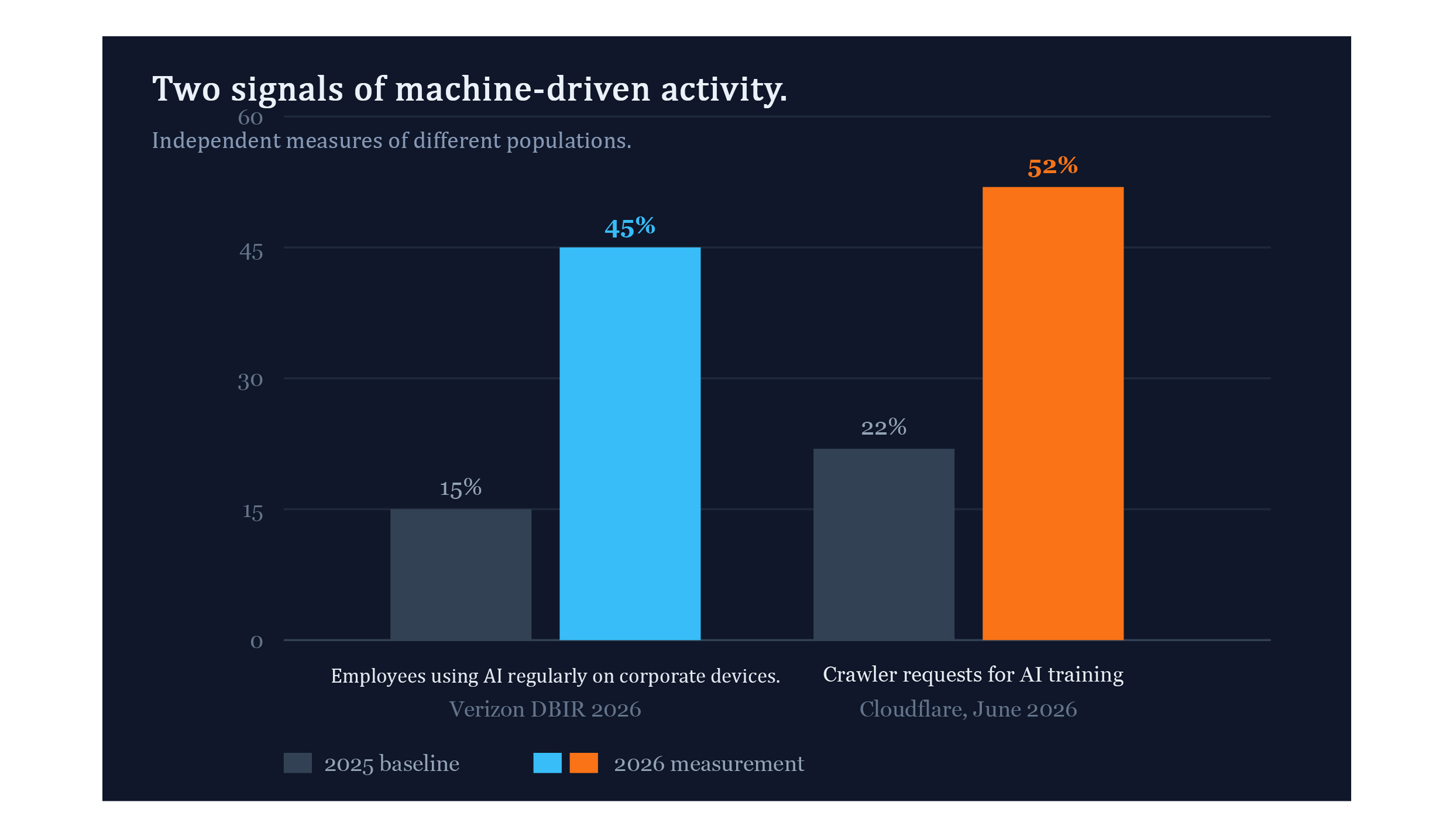
  • The evidence is moving fast. Regular employee use of AI on corporate devices tripled in one year, from 15% to 45%, and two-thirds of users reach AI services through personal accounts (Verizon DBIR 2026). On the open web, the share of crawler requests made for AI training rose from 22% to 52% (Cloudflare, 2026).
  • Regulators have already named the artefact they want for high-risk AI systems. EU AI Act Article 12 requires those systems to support automatic events logging over their lifetime.

Does human PAM carry over to AI agents?

Yes, and that is the trap. Most of what privileged access management (PAM) does for a human administrator transfer to an AI agent with modest engineering. You can vault the agent’s credential, broker its session, scope its entitlement, record what it did, and expire its access on a timer. That work is worth doing, and it is configuration rather than architecture.

The trap is treating that transfer as the finish line. Parity gives an agent the controls a human already had. It does not give you control for the four things an agent does that a human never does.

What already transfers cleanly

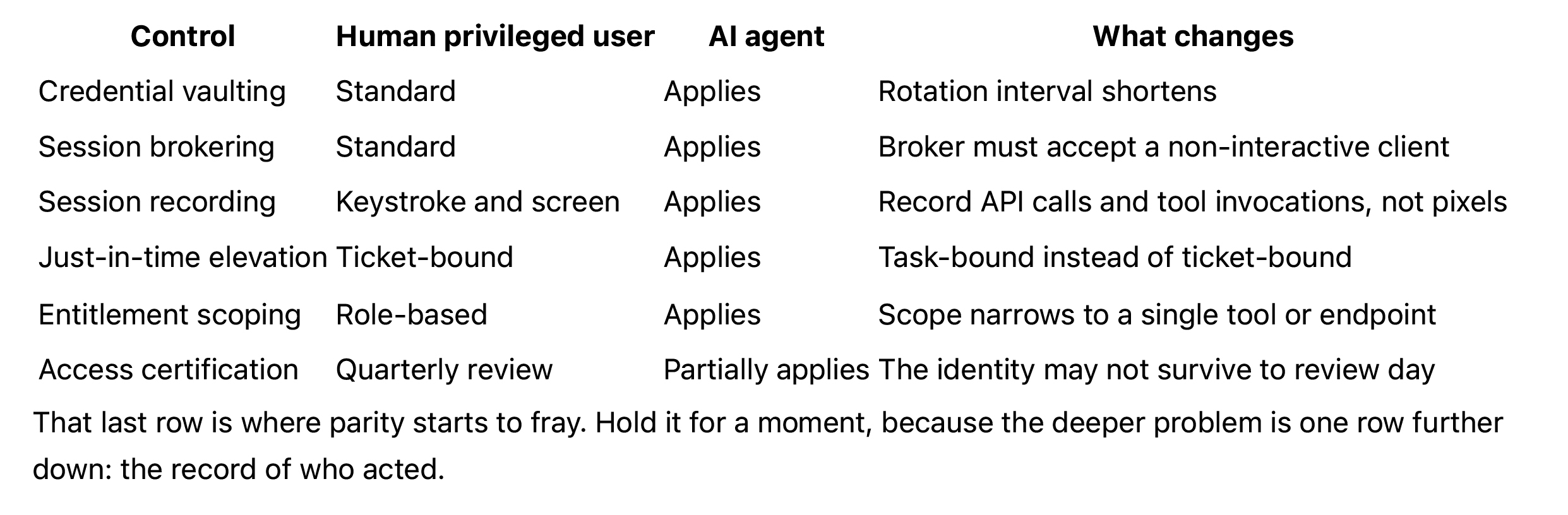
Start with the honest half of the answer. These controls need configuration work, not new architecture.

That last row is where parity starts to fray. Hold it for a moment, because the deeper problem is one row further down: the record of who acted.

Where parity runs out

⦁ Delegation: the chain is recorded, then ignored

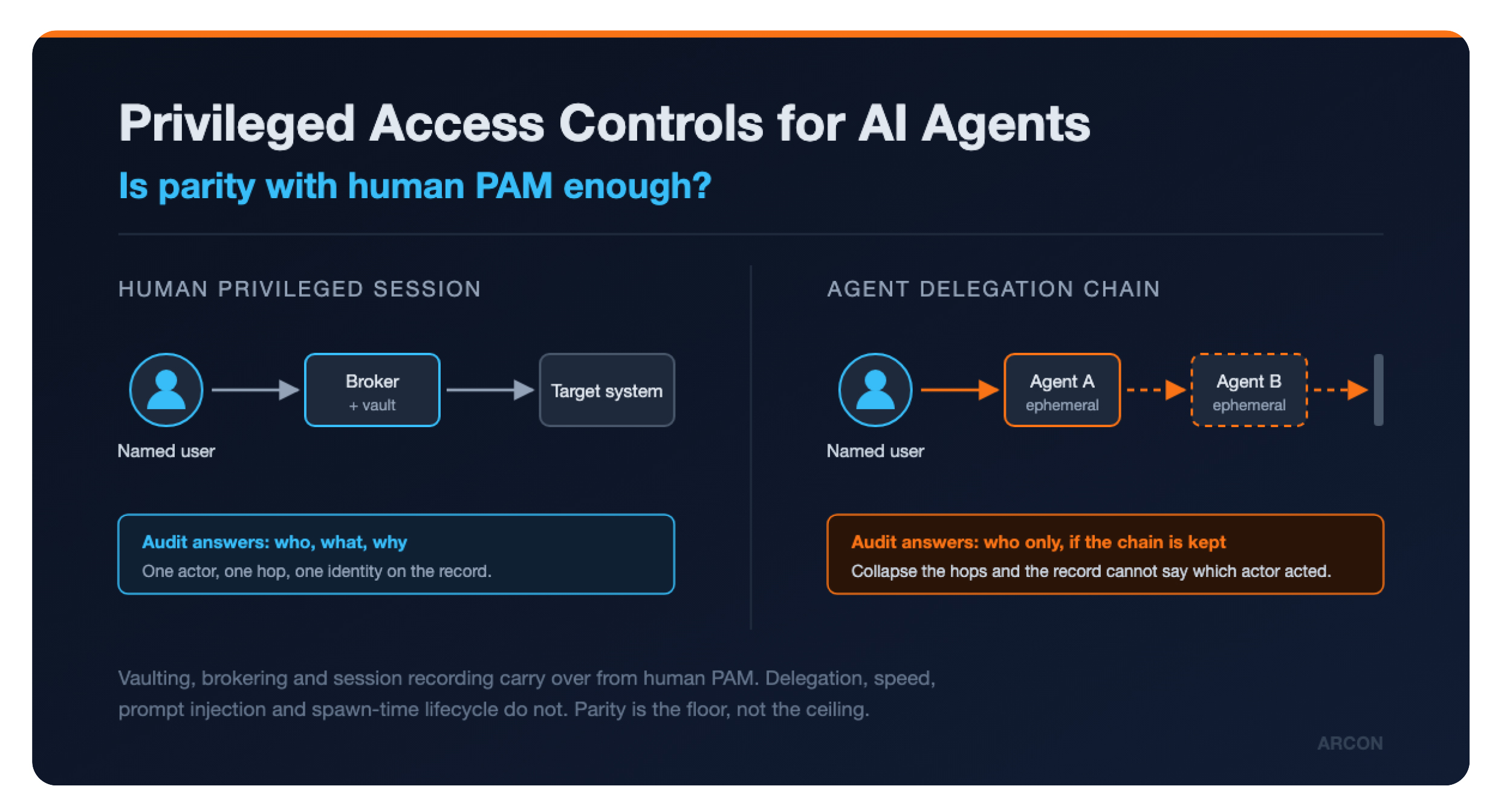
A human privileged session has one actor. An agent chain has several. A person asks an orchestrating agent to close the quarter. That agent spawns a second agent to read the ledger and a third to write to the reporting database. Four identities, one intent, one write.

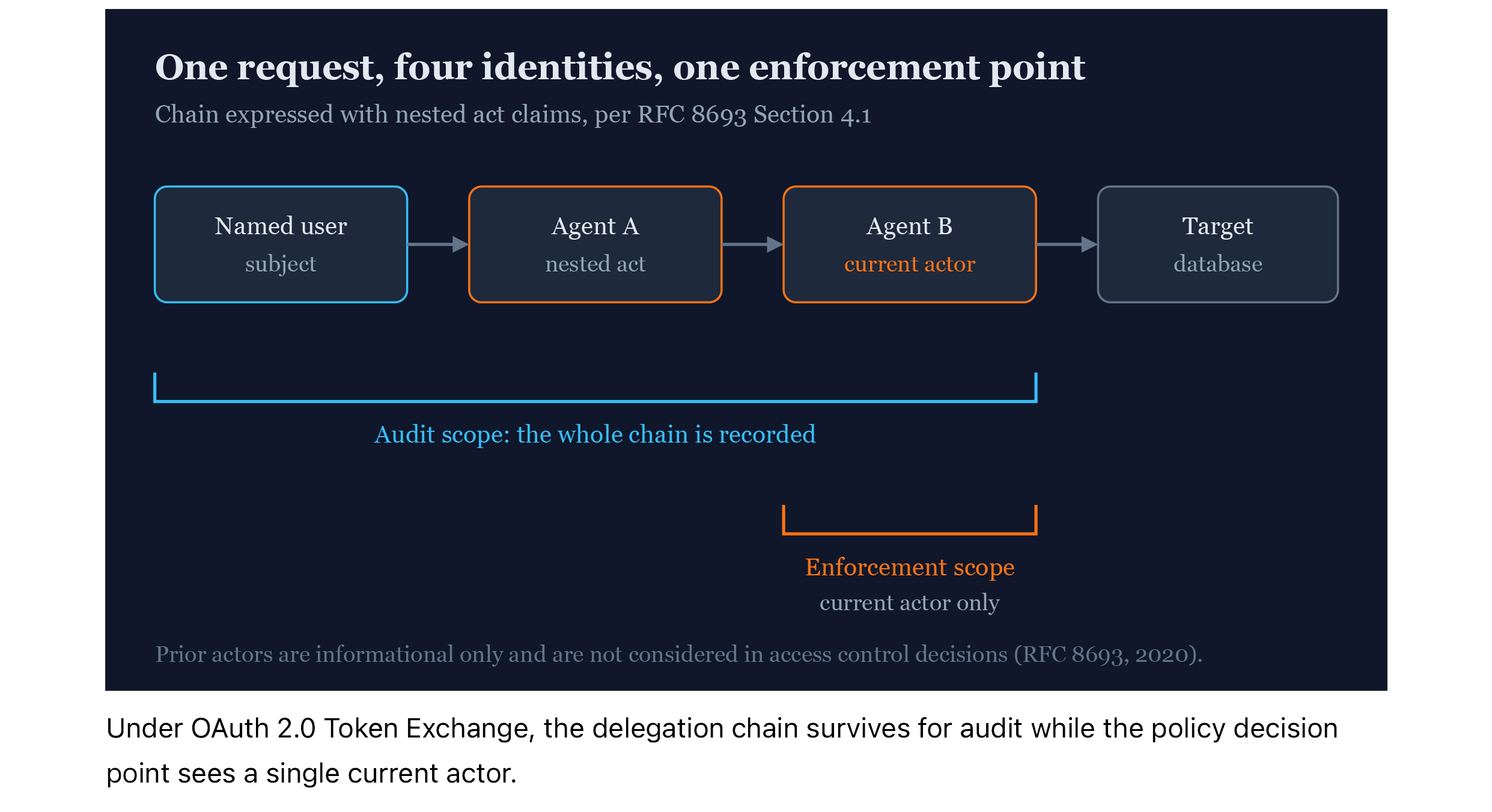
The standard that governs this case is RFC 8693, OAuth 2.0 Token Exchange (IETF, 2020). It gives you exactly the primitive you would want. An carries “the identity of the acting party,” and nested claims express a chain of delegation, with the least recent actor most deeply nested.

Then Section 4.1 draws the line that most architecture diagrams miss:

“For the purpose of applying access control policy, the consumer of a token MUST only consider the token’s
top-level claims and the party identified as the current actor by the claim. Prior actors identified by any
nested claims are informational only and are not to be considered in access control decisions.”

Read that as an operator. The chain is preserved for audit. It is normatively excluded from enforcement. The resource server that consumes the token sees one actor, whatever depth produced the request. The authorization server performing the exchange is not bound the same way. It can evaluate the full chain before issuing the token at all, which makes issuance the natural place to cap delegation depth or refuse an actor combination.

Human PAM rarely had to answer this at depth, because a privileged session usually carried one identity from start to finish.

⦁ Lifecycle: identities born and destroyed inside one task

Certification cycles assume the identity is still there when the reviewer arrives. Agent identities are not frequent.

The Cloud Security Alliance made this argument plainly in April 2026. Its post, “We Are Fixing the Wrong Problem in Non-Human Identity Security,” puts it bluntly: “NHIs are not ‘accounts’. They are autonomous trust executors.” Identities are spawned on demand. Credentials live for seconds or minutes. Trust is delegated at runtime, not provisioned in advance.

If that is true, an inventory is a photograph of a room that has already emptied. The control must move to issuance and expiry, not to the register. Non-human identity (NHI) work that starts with a discovery scan and ends with a spreadsheet will keep finding a different population every time it runs.

The US National Institute of Standards and Technology asked the same question in February 2026. Its concept paper on software and AI agent identity puts it directly: should agent identity metadata be ephemeral, or is it fixed? The paper does not answer. That is the useful part. The body working on this has published the open question rather than a settled control.

⦁ Tempo: approvals designed around a human pause

A JIT approval workflow works because a person waits. An agent does not wait, and there are a lot of them.

Cloudflare reported in July 2026 that more than 50% of traffic on the internet is now non-human. In the same report, crawler requests made for AI training reached 52% as of June 2026, up from 22% in Spring 2025. The Verizon 2026 Data Breach Investigations Report, its 19th edition, records AI bot traffic growing 21% month over month.

At that rate, a control that costs a human ten seconds per approval is not a control. It is a queue. The design answer is policy that decides with no human in the path. The human decision moves up a level: which task classes an agent may ever perform, not which call it may make now.

⦁ Instruction integrity: privilege the agent was persuaded to use

This failure mode has only a partial human analogue. A human administrator with valid credentials can be socially engineered, but the attack must pass through a person. An agent’s instructions are data, and data arrives from the systems it was authorized to read.

OWASP catalogues this as LLM06:2025 Excessive Agency. Its framing is precise: “The root cause of Excessive Agency is typically one or more of: excessive functionality; excessive permissions; excessive autonomy.” Note what is absent from that list. There is no compromised credential. The agent used exactly the privilege you granted, on an instruction it should not have followed.

Sender-constrained tokens help with the adjacent problem. RFC 9449, Demonstrating Proof of Possession (IETF, September 2023) binds a token to a key so a stolen token cannot be replayed. It does nothing about a legitimate token used for an illegitimate purpose. That gap is the one worth budgeting for.

How fast is the non-human side growing?

Two independent measurements, one year apart, pointing the same way.

Employee use of unsanctioned AI tripled in one year; crawler requests attributed to AI training more than doubled over a similar window.

The same Verizon edition found that 31% of breaches now start with vulnerability exploitation. It reports this as the first time in 19 years that exploitation has been stolen credentials as the biggest point of entry. Third-party involvement rose 60% and now appears in 48% of breaches.

Those two findings matter together. Credential theft is no longer the whole story, and the supply chain is where a growing share of the damage travels. Agent identities live at exactly that junction: they are non-human credentials that call third-party services on your behalf.

What auditors will ask for

Regulators moved before the architecture settled, and they picked the log.

EU AI Act Article 12, Record-Keeping requires that high-risk AI systems “shall technically allow for the automatic recording of events (logs) over the lifetime of the system.” The traceability level must suit the intended purpose.

The date that obligation lands on was rescheduled in 2026. Regulation (EU) 2026/1744, the Digital Omnibus on AI, amended Article 113 and moved the high-risk obligations back. Article 12 now applies from 2 December 2027 for systems classed high-risk under Annex III, and from 2 August 2028 for those classed high-risk under Annex I. The original text of Regulation (EU) 2024/1689 set 2 August 2026 and 2 August 2027; a roadmap still built on those two dates is planned against a superseded calendar.

Note the phrase “over the lifetime of the system.” That is a logging-capability requirement on the system. Articles 19 and 26(6) then require providers and deployers to keep those logs for at least six months. Both apply to an identity population whose individual members may last seconds, so meeting them is a design decision made at issuance, not a reporting decision made at audit.

The NIST concept paper frames the same requirement as an open technical problem. It asks how agents can log their actions and intent in a tamper-proof, verifiable way. It asks how to bind an agent’s action back to the human who authorized it. The paper also draws an honest boundary: access for external agents from untrusted sources is excluded from that first effort. A reference architecture for agents you do not control is not coming this cycle. Whether these obligations apply depends first on whether a given system is classed as high-risk. Many agents performing IT operations will not be.

A test you can run against your own estate

Five questions. Each one is answerable from systems you already have, and each has a specific artefact as the
answer.

  • Pick one agent write action from last week. Can you name the human it traces to? If the answer requires joining three logs by timestamp, the chain is not being carried, only inferred.
  • How long did the credential for that action exist? If the answer is measured in months, you have a service account wearing an agent’s name. Compare against your just-in-time privilege policy for humans, then explain the difference.
  • What happens at approval time when the agent runs at three in the morning? If the workflow waits for a person, the control degrades to whatever the fallback is. Find out what the fallback is.
  • Which tools can that agent call that its task does not require? This is the excessive functionality case from OWASP LLM06, and it is usually an inherited integration, not a decision anyone made.
  • If a regulator asked for the full action log for one agent for one quarter, could you produce it? Including for agents that no longer exist.

An estate that answers all five has moved past parity. An estate that answers the first three has done the PAM work well and has the delegation and evidence work still ahead. Whether your agents are already in production or still in pilot, ARCON recommends that security teams be able to answer five questions. Each is answerable from systems you already have, and each has a specific artefact as the answer.

Where this leaves an identity team

Parity is on the floor. Do it. The alternative is an agent population with no vault, no broker, and no record. Every control that transfers is a control you do not have to invent.

Then plan for the part that does not transfer. Carry the delegation chain in your own audit record, and enforce depth limits at issuance, since the token standard will not enforce on the chain at the resource. Move non-human identity governance from inventory to issuance. Set approval at the task-class grain rather than the call grain. Treat tool scope as a permission boundary, because OWASP says that is where the root cause usually sits.

Much of this builds on controls you already own. It requires the converged identity view that already tells you which human owns which entitlement, extended so the record does not stop at the first machine. The same argument that makes Zero Trust workable for humans applies here, one hop further down.

The next audit cycle will ask for evidence, not architecture. Start with question five.

About ARCON

ARCON builds privileged access, endpoint privilege, identity governance, and cloud entitlement controls for regulated enterprises. Estates covered include on-premises, cloud, and hybrid. This post was drafted with AI assistance and reviewed before publication.

Claims here about agent delegation and non-human identity describe published standards and research, not product behaviour. A named subject-matter expert reviews any security capability claim before it is attached to them. Questions about your own environment go to our team via the contact page. Related material is indexed under compliance.

Sources

  • Internet Engineering Task Force, “RFC 8693: OAuth 2.0 Token Exchange,” 2020. & RFC 8705
  • Internet Engineering Task Force, “RFC 9449: OAuth 2.0 Demonstrating Proof of Possession (DPoP),” 2023.
  • Verizon, “Verizon 2026 Data Breach Investigations Report,” 2026.
  • National Institute of Standards and Technology, National Cybersecurity Center of Excellence, “Accelerating the Adoption of Software and AI Agent Identity and Authorization,” concept paper, 2026.
  • OWASP Gen AI Security Project, “LLM06:2025 Excessive Agency,” 2025.
  • European Union, “EU Artificial Intelligence Act, Article 12: Record-Keeping,” Regulation (EU) 2024/1689, consolidated text as amended, 2026.
  • European Union, “EU Artificial Intelligence Act, Article 113: Entry into Force and Application,” Regulation (EU) 2024/1689 as amended by Regulation (EU) 2026/1744 (Digital Omnibus on AI), in force 27 July 2026.
  • Cloud Security Alliance, “We Are Fixing the Wrong Problem in Non-Human Identity Security,” 2026.
  • Cloudflare, “Content Independence Day, one year on: building the business model for the agentic Internet,” 2026.

How DoYou Remove Local Admin Rights Without Breaking Productivity?

Standing local admin is a rollout problem, not a policy problem. A five-step sequence for removing local admin rights without a helpdesk revolt.

Local admin is the easiest privilege to grant and the hardest to take back. Most attempts stall in the same place. Enforcement lands before anyone knows what it will break, the helpdesk queue spikes in week one, and the policy is withdrawn before steady state.

Least privilege is not a policy, it is an enforcement problem. The five steps below run in the order a working deployment runs.

Key Takeaways

  • Run the endpoint privilege agent in audit mode for a full business cycle before enforcing anything. Observed behaviour writes a better policy than a workshop does.
  • Capture three baselines in that window: share of users holding standing local admin, elevation events per user per week, and admin-related tickets per 100 users.
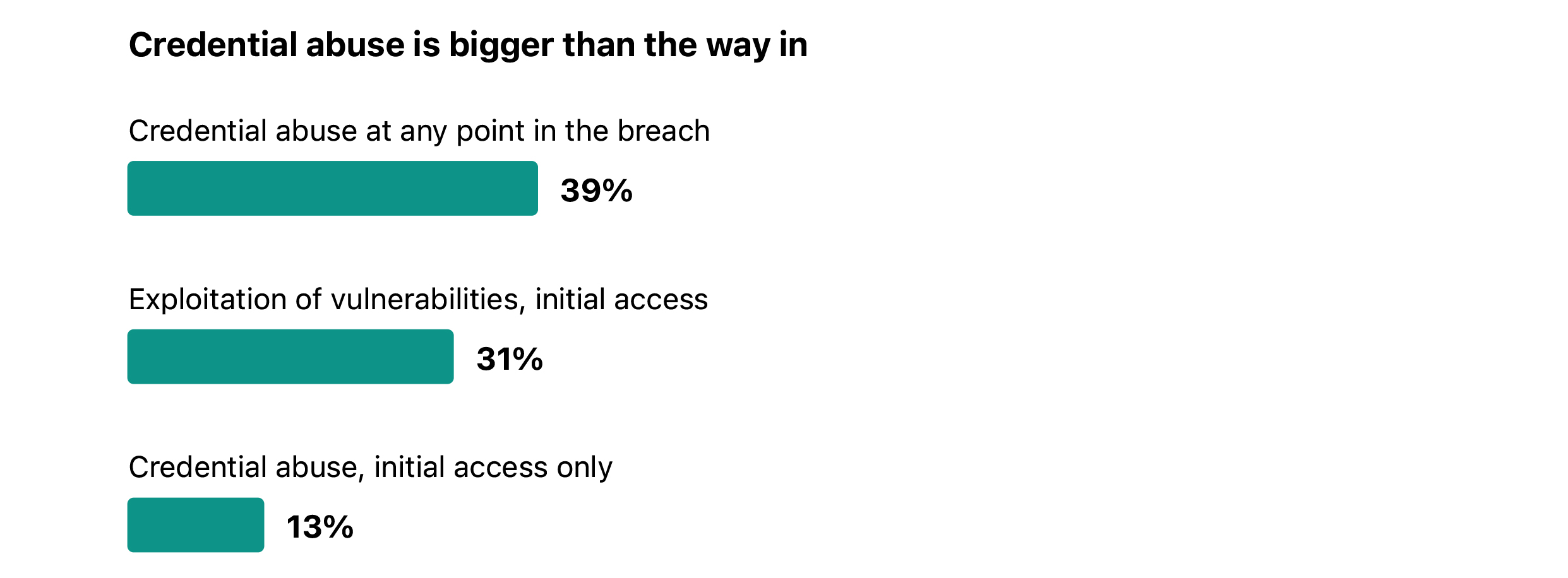
  • Verizon’s 2026 DBIR finds credential abuse at some point in 39 percent of breaches, well above the 13 percent it opens. Standing local admin is what makes the steps after the first host cheap.
  • A self-service elevation path faster than a ticket is what protects productivity. Without one, users route around the control or the control gets withdrawn.

Why standing admin rights are still the exposure you control

Verizon’s 2026 Data Breach Investigations Report counts credential abuse in 39 percent of breaches when you look at every stage of the intrusion rather than only the way in. Verizon’s own wording is that credential abuse “is pervasive across various attack paths and is a legitimate mitigation target chokepoint”. Standing local admin is what makes that chokepoint cheap to pass through, and the recurring reasons breaches succeed point the same way.How DoYou Remove Local Admin Rights Without Breaking Productivity

Source: Verizon, 2026 Data Breach Investigations Report. Initial access shares are drawn from nonError, non Misuse breaches (n=20,023). The 39 percent counts credential abuse at any stage of the breach progression.

The mechanism is narrow. Standing local admin means one compromised session already holds the privilege to
disable local defences, install a service, read credentials from memory, and reach the next host. Removing it does
not stop the session being compromised. It removes the step that makes everything after the first host cheap.

Be honest about the boundary. Removing local admin does not stop phishing, valid credentials abused against cloud applications, or a vulnerable internet-facing service. In the 2026 DBIR, exploitation of vulnerabilities is now the leading initial access vector at 31 percent, up from 20 percent, and that share belongs to patching. Credential abuse opens only 13 percent of breaches as the first recorded action, and Verizon notes that number fell partly because it began counting pretexting separately this year. The case for removing standing admin rests on the 39 percent, not the 13.

Why admin rights removals fail

Three failure modes account for most rolled-back projects.

Enforcement before discovery. The policy comes from a stale inventory, so the first wave blocks work nobody
knew was privileged.

No elevation path faster than a ticket. When a legitimate elevation means a queue measured in hours, the
business escalates until the policy is suspended.

One policy across unlike populations. Finance, engineering and field sales do not elevate for the same reasons,
so a blanket rule is either too tight for engineering or too loose for everyone else.

Under all three sits one miss: nobody owned the exception queue, so exceptions became permanent.

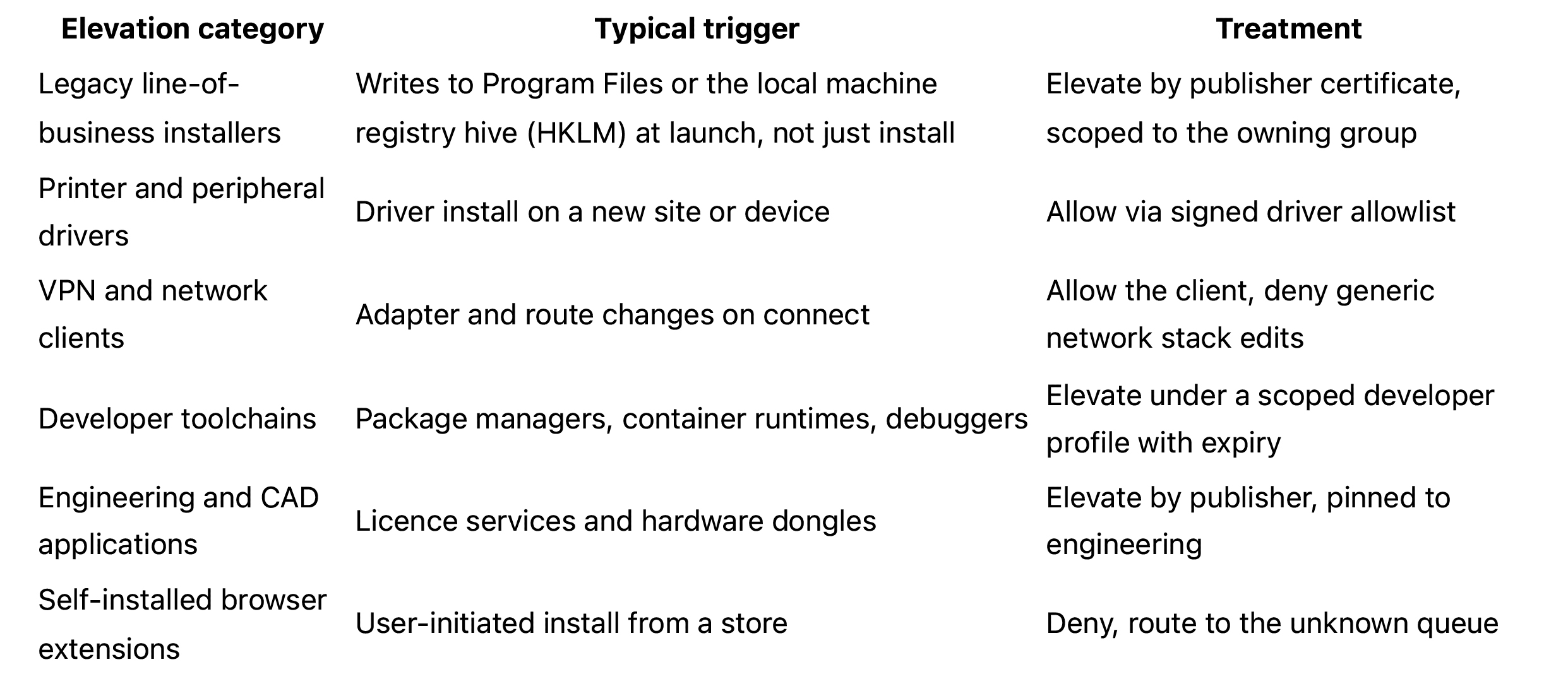
What actually breaksHow DoYou Remove Local Admin Rights Without Breaking Productivity

Coverage: macOS, offline laptops and servers

State the boundaries before you commit a date. On Windows the pattern above is complete. On macOS the enforcement primitives differ, so macOS needs its own policy set and pilot, not a translated copy. On offline laptops cached policy keeps enforcing and requests queue, so the user gets allow and deny verdicts but no fresh human approval. Servers are a separate control domain, so scope them apart.

Step 1: Run in audit mode first and let behaviour write the policy

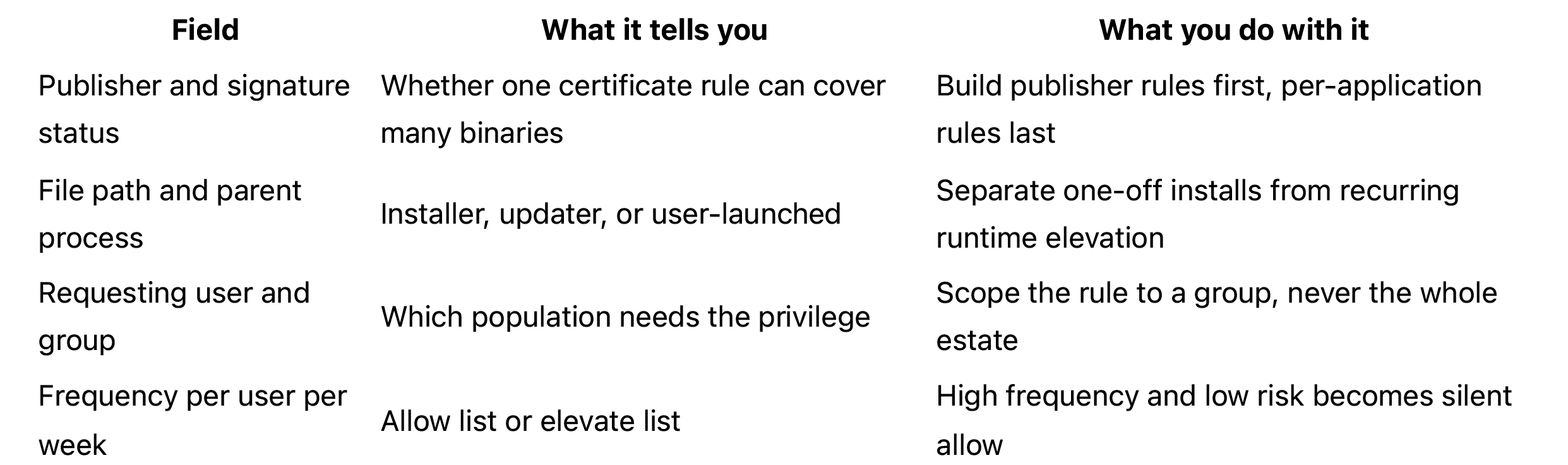
Audit mode logs every elevation attempt and blocks nothing. Run it for a full business cycle including month-end, because the finance close is where the unusual elevations live. Two weeks is not a business cycle. Auto profiling turns that log into a central inventory. Read the output in this order, because the order turns raw events into a defensible policy:How DoYou Remove Local Admin Rights Without Breaking Productivity

While that window runs, capture three baselines. You get no second clean chance at them:

1. Share of users holding standing local admin, counting local accounts as well as directory-joined ones.
2. Elevation events per user per week.
3. Admin-related helpdesk tickets per 100 users.

Then segment before writing a single rule. Group by line of business and role, and look for populations whose elevation profile is genuinely different, not merely differently named.

Step 2: Allow,deny,elevate,and who each rule applies to

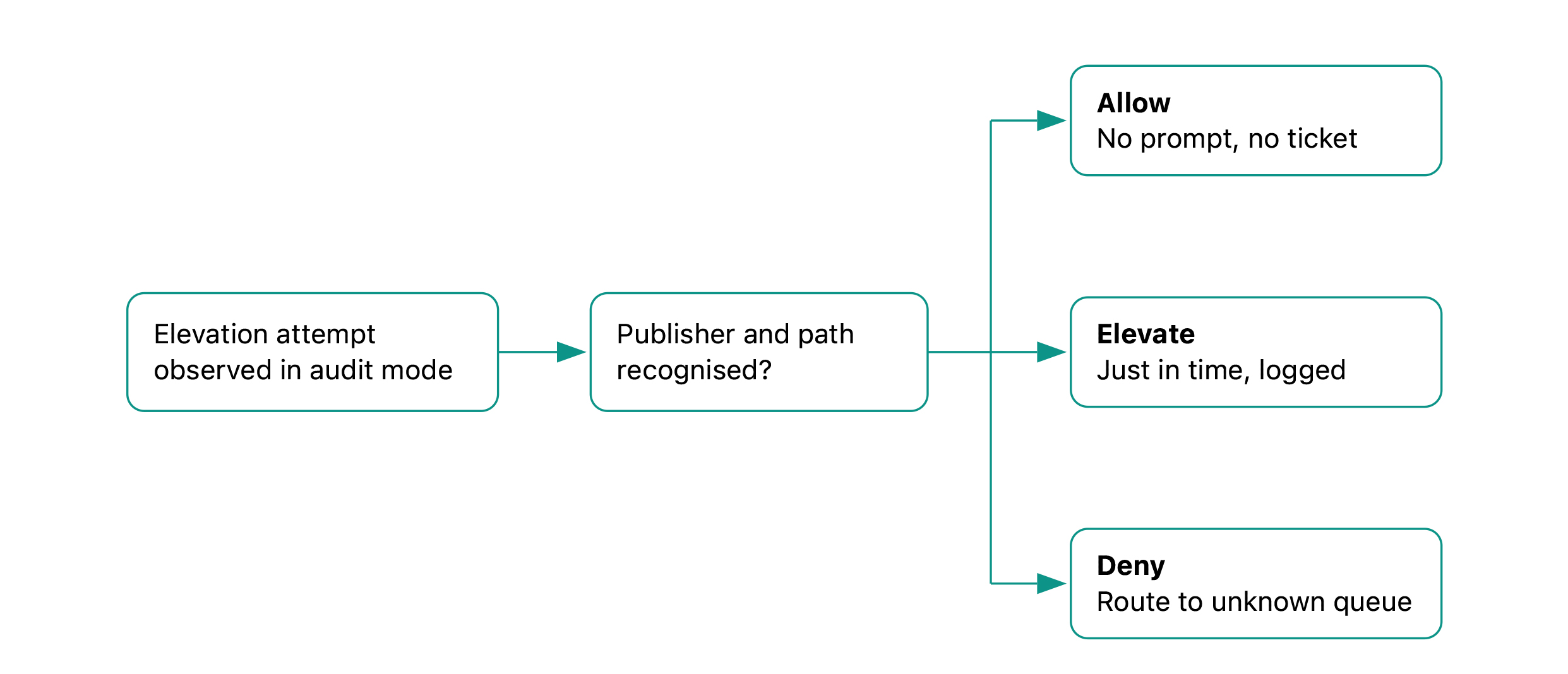
Every observed behaviour resolves to one of three verdicts.

Allow means the action runs with the privilege it needs and the user sees nothing, as with a signed printer driver from an approved vendor. Elevate means the action is permitted but brokered and logged, on a just-in-time grant that expires, as with a developer starting a local container runtime. Deny means the action is refused and routed somewhere a human can look at it, as with a self-installed browser extension.How DoYou Remove Local Admin Rights Without Breaking Productivity

Every elevation observed in Step 1 resolves to one of three verdicts, scoped to a group rather than to the whole estate.

Scope each rule to a group or line of business. The opposite trap is a rule per team, which produces hundreds of policies nobody can audit. Keep the count near the number of genuinely distinct elevation profiles.

Prefer publisher and certificate rules over per-application rules. One certificate rule covers every current and future binary from that vendor. A per-application rule needs maintenance at every version bump, so reserve those for legacy software whose signing is unreliable.

Leave some things deliberately permissive in phase one. Shipping a narrow policy on time and tightening it in phase two is a schedule decision, not a security failure.

Step 3: Give users a path fasterthan a ticket

This is the half of the title most projects underbuild. If elevation is slower than the workaround, the workaround wins.

Just-in-time self-service elevation should read like this to the user. Right-click and request elevation, pick a reason from a short list, add a line of context, receive the grant, continue working. No ticket number typed by hand, and the grant expires on its own.

Design the approval split before you switch it on. Low-risk categories seen repeatedly in audit mode autoapprove. Anything touching security tooling, or from an unrecognised publisher, needs a named human. Publish an approval target you can meet during business hours, and staff it, because a missed target teaches users to stop asking.

Write the request and its outcome back to the IT service management (ITSM) system. The audit trail and the helpdesk should read one record, not two that disagree.

Then plan the failure modes. Time-boxed break-glass local admin, granted for a fixed window and logged loudly, stops a field engineer being stranded. Decide in advance what happens when the elevation service is unreachable: cached policy keeps enforcing allow and deny, and queued approvals resume on reconnect. Agree the rollback trigger with the business before enforcement day, in writing, with a number attached.

Step 4: Handle the unknowns instead of blocking them

Deny-by-default on unknown publishers is correct, and it is also what generates the ticket spike. Every piece of niche, regional or internally built software your inventory missed arrives at the helpdesk that same morning.

Sandboxed observation gives that queue somewhere to go. The pattern, sold under several names across the endpoint privilege category, runs the unknown application in an isolated context and records what it writes, what it registers, and what it reaches out to, while the user keeps working. The output supports one decision: allow list, elevate list, or neither. Treat it as a criterion to test during evaluation rather than a given, because isolation depth and what actually gets recorded vary widely.

Feed every verdict back into the lists. Done consistently the queue shrinks week over week, because each decision covers a publisher rather than one binary.

The honest limit: sandbox observation tells you what an application did during observation, not what it will do under different conditions or after an update. It reduces the unknown queue. It does not replace a software approval process.

Step 5: Prove it

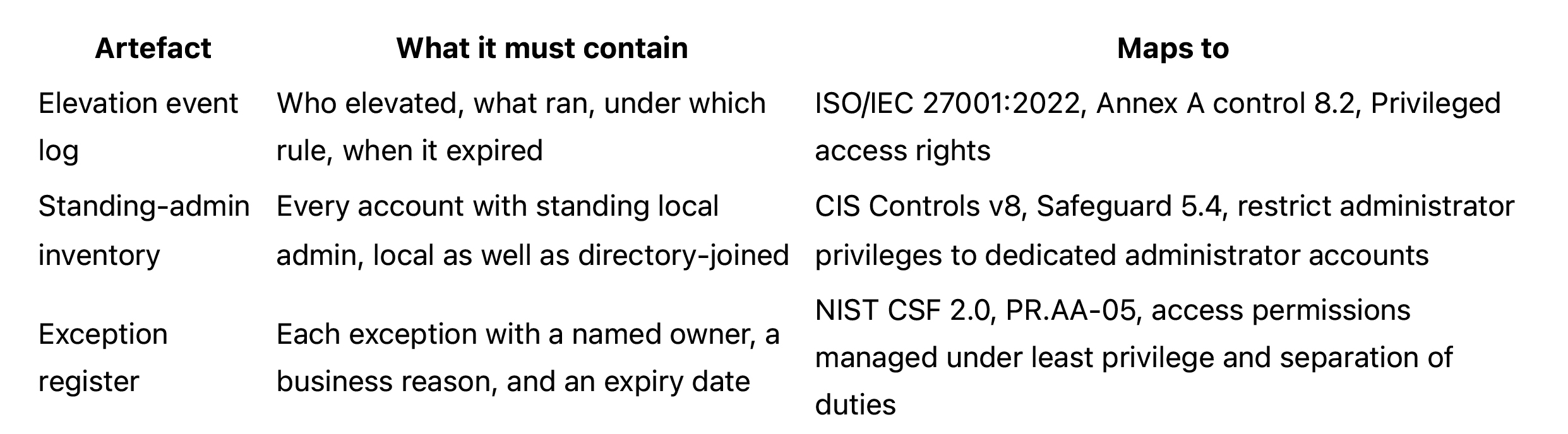
Three artefacts carry the evidence, each mapping to a named control.How DoYou Remove Local Admin Rights Without Breaking Productivity

Set a cadence that survives contact with reality: an operational review monthly, a risk committee summary quarterly. Anything more frequent stops happening by month four.

Agree the export columns with the auditor before the first review, not after. The elevation log needs timestamp, user, host, process and command line, the rule that matched, the approver where one was involved, and the expiry. The standing-admin inventory needs account, host, how the privilege was granted, and the date last reviewed. The exception register needs owner, business reason, compensating control and expiry.

Export in a format an auditor can approve rather than rebuild. A dated, filterable export tied to the control reference beats a screenshot pasted into a slide, and it decides whether the auditor confirms your evidence or reconstructs it.

Rollout timeline and the numbers you report upwardHow DoYou Remove Local Admin Rights Without Breaking Productivity


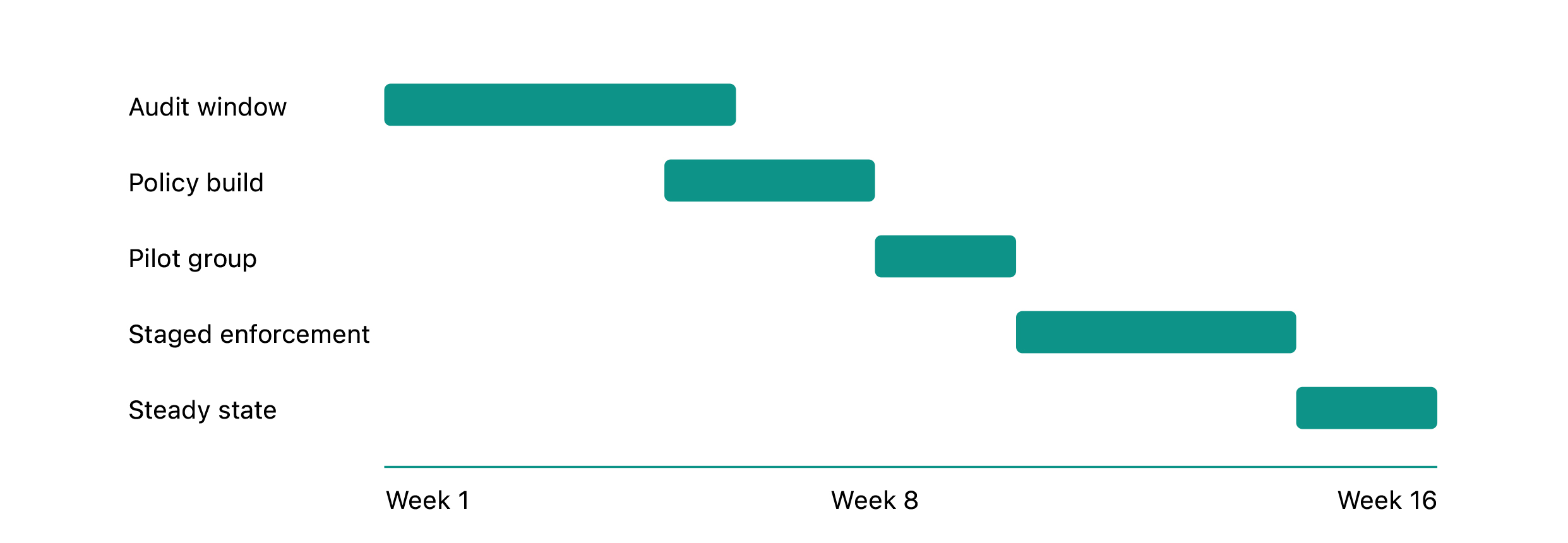
A phased sequence with named gates. Each phase starts only when the previous one has produced its artefact.

The gates matter more than the dates. Audit ends when you hold the three baselines. Policy build ends when every rule is scoped to a group. The pilot covers one willing line of business. Enforcement takes one population at a time. Steady state begins when the exception register has an owner and a review date.

Three numbers go upward, each with a Step 1 baseline and a target set at kickoff:

  • Share of users with standing local admin. Target zero outside the exception register.
  • Elevation approval time against target. Pick a target you can defend, say fifteen minutes during business hours, and report the miss rate, not the average.
  • Admin-related tickets per 100 users. Reported monthly against the audit-window baseline.

Say the shape of the ticket curve out loud before week one, because the curve is what scares sponsors. Tickets rise in the first wave as unknown software surfaces. They fall as publisher rules and sandbox verdicts absorb the queue, then settle below baseline once self-service elevation carries the routine cases. A week-one rise is the programme working. Do not attach a percentage to the fall unless you have measured your own.

Next step: the same sequence, expanded with each gate’s criteria and the artefact each phase produces, sits in our endpoint privilege management rollout guidance.

About the author

ARCON (ARCON TechSolutions Pvt. Ltd.) builds privileged access management and endpoint privilege management technology for regulated enterprises across banking and financial services, healthcare, manufacturing, government and energy. This piece was written by the ARCON editorial team for the infrastructure and identity teams who run these rollouts. Company profile: ARCON on LinkedIn.

Not sure of your three baseline numbers yet? A privilege exposure assessment produces them without
touching enforcement. Talk to the team.

Sources

  • Verizon, 2026 Data Breach Investigations Report (2026), Figures 10 and 11 and the Results and analysis section: report
  • ISO/IEC 27001:2022, Annex A 8.2 Privileged access rights: standard
  • CIS Controls v8, Safeguard 5.4: controls
  • NIST, Cybersecurity Framework 2.0, PR.AA-05: CSWP 29

Just-in-Time Elevation vs Standing Admin Rights: What Breaks?

Just-in-time elevation removes standing admin rights from the endpoint. Here is what breaks on day one, which pattern to pick, and how to prove it to an auditor.

Key Takeaways

  • Just-in-time (JIT) elevation replaces standing admin rights with administrator privilege that exists only while a task runs.
  • Zero standing privilege means no account on the endpoint holds administrator rights while no task is running.
  • These deployments fail for one reason above all others: when the approved path is slower than the
    workaround, the workaround wins.
  • This post covers endpoints and workstations. It does not cover servers, domain controllers, or cloud consoles.
  • Time-bound elevation still leaves a privileged identity in place between uses. An ephemeral account does not.

Why the just-in-time elevation project stalls between intent and reality

Open the local Administrators group on ten of your endpoints. Count the named members. Then count how many were added for something that was supposed to last an afternoon. That number is the real distance between justin-time elevation and standing admin rights in your estate, and no vendor survey can tell it to you. Most teams
find two categories: the members they expected, and a longer tail nobody can explain.

It is tempting to justify the work with a credential-theft statistic. The current numbers do not support that framing. The Verizon Data Breach Investigations Report 2026 puts vulnerability exploitation first among known initial access vectors, at 31 percent of the breaches it counts. Credential abuse, the previous leader, accounts for 13 percent (Verizon DBIR 2026, reported by Infosecurity Magazine, 2026).

That is the better argument, not a weaker one. If the way in is now an unpatched service rather than a stolen password, the control that matters is what the intruder inherits on arrival. On most endpoints, what they inherit is a standing local administrator token.

JIT elevation removes that token. Deployments stall in three predictable places: approval takes longer than the workaround, some applications refuse to start without administrator rights, and nobody owns deprovisioning once the pilot ends. JIT is not one control. It is four mechanisms that have to hold together, and this post covers endpoints and workstations only. Each mechanism is below, in the order that decides whether the project survives contact with users.

What standing admin rights actually mean on an endpoint

Standing privilege is any administrator right that exists while no task is running. On a Windows endpoint it takes four common forms.

  • A named user sitting in the local Administrators group.
  • A domain group nested into local Administrators, which hides the real membership behind a directory lookup.
  • Permanent elevation granted by policy, where the account is not a member but the rights arrive anyway.
  • A shared local administrator account with a common password across the fleet.

There is a fifth form most inventories miss. Services, scheduled tasks, and installers configured to run under a privileged local identity hold administrator rights permanently, and no user-facing elevation workflow touches them.

The shared account is the worst of the four. It gives no attribution, so a session cannot be tied to a person. It cannot be revoked without a password reset on every machine that uses it. And one password recovered from one endpoint unlocks the rest of the fleet.

This is not a niche concern. US federal red and blue teams rank improper separation of user and administrator privilege among the ten most common misconfigurations they find. Their remediation names both halves of the
fix: keep privileged accounts off general tasks, and provision just-in-time access when it is needed (CISA and NSA, AA23-278A, 2023).

Least privilege is not a policy, it is an enforcement problem. Standing membership is where the enforcement gap
lives, because the policy document says temporary and the group membership says permanent. If the boundary
between disciplines is still fuzzy on your team, how endpoint privilege management differs from privileged access
management sets it out.

Making approval fasterthan the workaround

Here is the governing rule for the whole project. If a legitimate request takes longer than the workaround, the workaround wins. Standing admin rights are the workaround. Every minute you add to the approval path is an argument for keeping them.

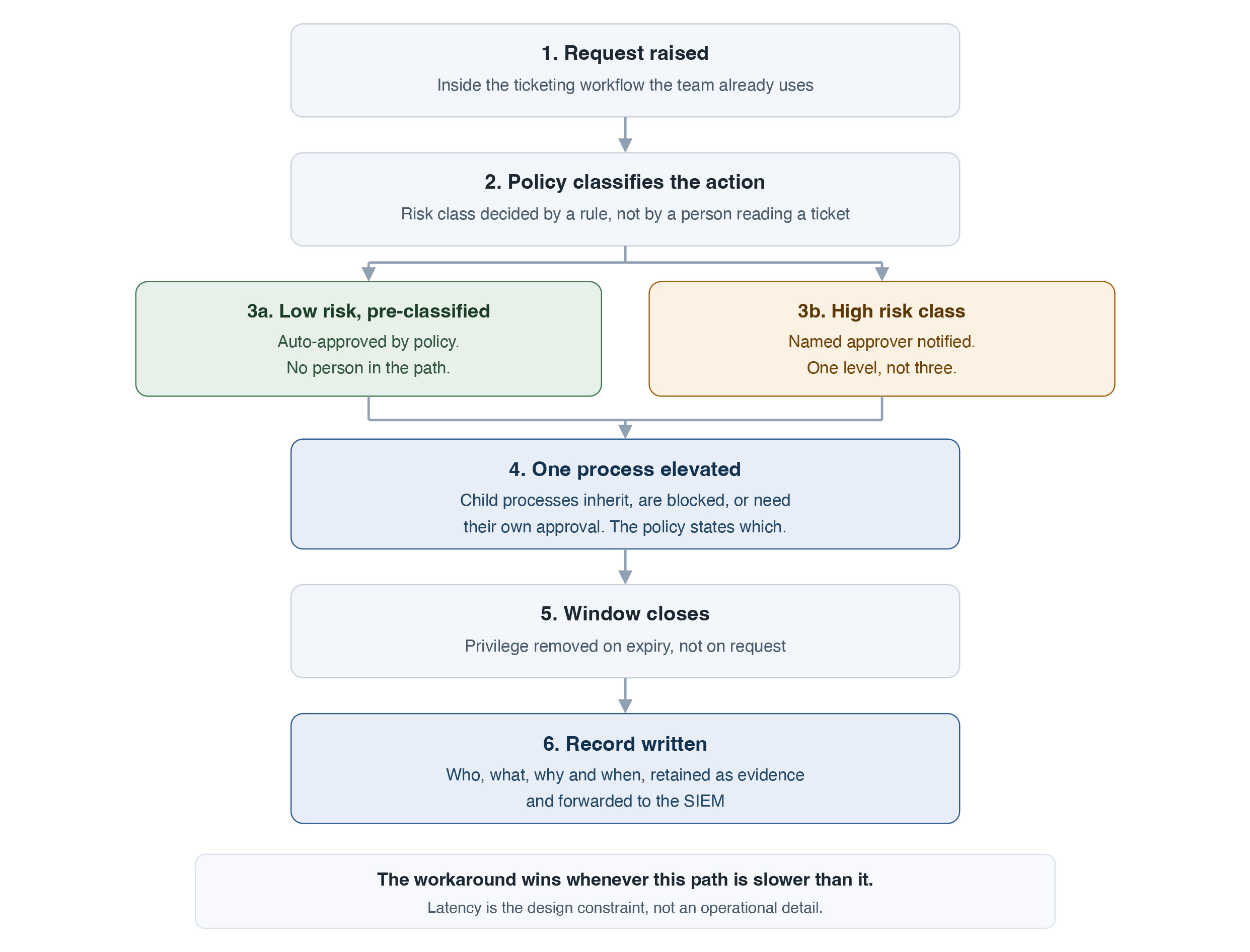
Reduce the latency in this order.

  1. Policy-based auto-approval for pre-classified low-risk actions. A signed printer driver from an approved publisher does not need a person. Decide the risk class once, in a rule, and the request resolves in seconds.
  2. Multi-level approval reserved for high-risk classes only. Two approvers on a kernel driver install is proportionate. Two approvers on every request teaches users to route around you.
  3. Integration with the ticketing system the team already lives in. A request that never leaves that workflow is a request nobody has to be trained on.

Just-in-Time Elevation vs Standing Admin Rights What Breaks?

The lifecycle of a single elevation request, from the ticket the user already had open to the record an auditor later reads. Stage 3 is where most of the elapsed time is won or lost.

What breaks on day one, and how to sequence around it:

  • Legacy applications that demand administrator rights at launch. Inventory them before you remove
  • anything, then put each one behind a rule that elevates the application, not the user.
  • Driver and peripheral installs. These are frequent, low risk, and the fastest win available to auto-approval.
  • Developer workstations. Build tooling, debuggers, and container runtimes raise elevation requests that a general office policy will not match. Treat them as their own policy set.
  • Laptops that are off the corporate network when the request is made. Decide the offline behaviour before rollout, not during it.

Two numbers tell you whether it worked. Track the median time from request to elevation, weekly. Track the count of standing-admin exceptions still open. Both are yours to collect. For the wider case on why this has become its own control problem, see why endpoint privilege now needs its own enforcement layer.

Fourjust-in-time patterns and when to use each

Four patterns cover almost every request you will see. They are not tiers, and they are not a maturity sequence.
Each suits a different shape of task.

Just-in-Time Elevation vs Standing Admin Rights What Breaks?

Two of these carry most of the volume. One-time elevation handles the installs. Time-bound handles the planned work. Extension exists so a real task does not push a user back into the queue mid-incident. Permanent with review exists so the exceptions stay visible instead of going underground.

The selection rule is one sentence. Choose by task duration and predictability, not by seniority. A senior engineer installing one signed package needs one-time elevation. A junior administrator running a four-hour migration needs a bounded window. Grade the task, never the person, or the pattern set turns into a rank chart and the exceptions follow the org chart.

Ephemeral admin accounts: nothing persists to be stolen

Time-bound elevation and an ephemeral admin account look similar from the ticket queue. They are not the same control.

Time-bound elevation leaves a privileged identity in place between uses. The account exists, its rights are dormant, and its credential can still be recovered from the machine. An ephemeral account does not exist before the task and does not exist after it. It is created for the work and removed when the work ends.

What changes for an attacker is specific. Credential-harvesting tooling run against an endpoint at rest finds no privileged local credential to take, because there is no privileged local account holding one.

The hard parts sit in the lifecycle, and an honest account of this pattern covers them.

  • Ownership left behind. Files and registry keys created during the task belong to an account that no longer exists. Decide the ownership target in advance, or you inherit orphaned access control entries on every machine.
  • The endpoint is offline at the wrong moment. Define the queued behaviour for creation and deletion, and define what happens if the machine never reconnects.
  • Deletion fails sometimes. A reconciliation job that finds and removes surviving accounts is not optional. Its output is the only real proof the pattern is holding.

Some identities still have to persist. That is the break-glass conversation, and it belongs in the section on what
this does not fix. Our endpoint privilege management ebook goes deeper into ephemeral account lifecycle than a
post this length can.

Parent-child process control: elevation that does not leak

Here is the chain that quietly voids a JIT deployment.

A user requests elevation to run an installer. The installer is elevated and runs. The installer spawns a command shell. The shell inherits the elevation token. The user then launches a browser from that shell, and the browser inherits it too.

Nothing in that sequence was approved except the installer. The elevation was scoped to one task and now covers whatever the user starts next, for as long as the shell stays open. Every control described so far still shows a clean record, because the request, the approval, and the expiry all behaved exactly as designed.

The control is to elevate the process, not the session. The policy names the executable, and it states explicitly what happens to child processes. There are three defensible answers. The wrong one is having no answer at all.

  • Children inherit, which is appropriate for an installer that legitimately spawns its own helpers.
  • Children are blocked, which is the safe default for anything a user can launch interactively.
  • Children require their own approval, which suits a small set of known chains.

You can verify your current behaviour today. Elevate one installer, let it spawn a shell, then inspect the integrity level and the token on the child process. If the child is elevated and nobody decided that it should be, the model has a hole in it.

What the auditor sees

An auditor does not ask whether you deployed JIT. They ask which control it satisfies and what evidence it produces. A working elevation workflow produces four artefacts.

  1. The request and approval record, showing who asked, who approved, and against which risk class.
  2. The elevation event log, showing who elevated, what was elevated, and why.
  3. Session screen capture for the high-risk classes only.
  4. Events forwarded to the security information and event management (SIEM) platform, so elevation is visible next to everything else.

Map those artefacts to named, numbered controls rather than to a general claim of least privilege.

CIS Controls v8.1 Safeguard 5.4 restricts administrator privileges to dedicated administrator accounts. General computing activity, such as browsing and email, runs from the primary non-privileged account (Center for Internet Security, CIS Controls v8.1, 2024). NIST SP 800-53 Rev. 5 covers the same ground under AC-6, Least Privilege. Its AC-6(5) enhancement sits in the Moderate and High baselines, not the Low one (NIST SP 800-53B, 2020).

ISO/IEC 27001:2022 addresses privileged access rights in Annex A control 8.2. That standard is paywalled, so paraphrase it and have a licensed copy checked before the wording enters a control matrix. For the fuller mapping across regimes, see how endpoint least privilege maps to NIS2, DPDP, ISO 27001 and CIS.

One distinction saves weeks of audit preparation. Evidence exported from a live elevation log is a record the reviewer approves. A report rebuilt at audit time from scattered sources is a claim the reviewer has to test.

There is an obligation the technical design usually misses. Screen capture of administrator sessions is employee monitoring. European guidance holds that employees can rarely give free consent. The processing therefore needs another lawful basis and a stated retention period (Article 29 Working Party, Opinion 2/2017 on data processing at work, 2017).

In Germany, the works council holds a statutory co-determination right over technical devices designed to monitor employee behaviour (Works Constitution Act, section 87(1) no. 6). Treat both as design constraints from the start, and take the specifics to counsel.

What just-in-time elevation does not fix

Four things sit outside this control. A deployment that pretends otherwise fails its first serious review.

  • Break-glass access. One path has to survive a broken approval service, a directory outage, or a network partition. That account is not eliminated. It is vaulted, its checkout is alarmed, and its use triggers a review by default rather than on request. Rotate its credential after every checkout, and name the person who reads the alarm. An alarm nobody owns is not a control.
  • Services, scheduled tasks, and installers already running under privileged local identities. These are configured, not requested. Removing local administrator rights from people does not remove them, and no user-facing elevation workflow touches them. They need their own inventory and their own owner.
  • Non-human and machine identities. Service accounts, API keys, and automation credentials have a different lifecycle and a different control problem. Endpoint elevation is the wrong tool for them. Where identity security is heading over the next few years covers that ground.
  • The endpoint that is offline when the request is made. Cached approval with a short ceiling, deny by default, or a local break-glass path are all defensible answers. Silence is not. Decide before rollout, because the field engineer on a customer site will decide for you otherwise.

The maturity ladder: where you actually are

Adjectives do not locate you. Counts do. Each rung below is a number you can produce this week.Just-in-Time Elevation vs Standing Admin Rights What Breaks?

The four rungs of endpoint privilege maturity, each stated as a countable test rather than an adjective. Produce the number for your estate before deciding which rung to build next.

  • Rung 0, standing. Named users hold persistent membership in local Administrators. Count the endpoints where that membership is non-empty at rest.
  • Rung 1, time-boxed. Every elevation is bounded by a window tied to a request record. Measure the median granted administrator hours per user per month.
  • Rung 2, ephemeral. The privileged identity is created per task and removed after it. Count the persistent privileged local accounts still in place.
  • Rung 3, zero standing. A scan at rest finds no privileged local account beyond a vaulted break-glass identity, and no child process inherits elevation.

For a security leader reporting upward, the ladder compresses into three lines. Name the rung you are on, using the count rather than a description. Name what the next rung removes, in terms of what an intruder would find on a machine at rest. Name what it costs, which is mostly integration work against your ticketing and directory estate.

At ARCON we implement rungs one and two through endpoint privilege management policy, and hold the breakglass identity in the enterprise vault rather than leaving it on the machine. That is a statement about which rung a capability implements, not a feature list. For the wider view, how privileged elevation fits alongside the rest of the identity estate is the next question most teams hit.

You are on a rung. The next one is a project, not a setting. If your count puts you on rung one, rung two is a build project rather than a configuration change. Download the endpoint privilege management ebook for what that build involves.

If you would rather watch the elevation path and the evidence trail run against your own policy set, talk to our team.

Sources

  • Verizon, 2026 Data Breach Investigations Report, 2026. Figures for initial access vectors as reported by Infosecurity Magazine, 2026, and CSO Online, 2026.
  • Help Net Security, coverage of the 2026 Data Breach Investigations Report, 2026.
  • Center for Internet Security, CIS Critical Security Controls Version 8.1, Safeguard 5.4, and the CIS Controls Assessment Specification for Control 5, v8.1, 2024.
  • National Institute of Standards and Technology, SP 800-53 Rev. 5, Security and Privacy Controls for Information Systems and Organizations, 2020, and SP 800-53B, Control Baselines, 2020.
  • International Organization for Standardization, ISO/IEC 27001:2022, Annex A control 8.2, “Privileged access rights”. Paywalled standard, paraphrased here rather than quoted.
  • Cybersecurity and Infrastructure Security Agency and National Security Agency, AA23-278A, NSA and CISA Red and Blue Teams Share Top Ten Cybersecurity Misconfigurations, 2023.
  • Article 29 Data Protection Working Party, Opinion 2/2017 on data processing at work (WP249), 2017.
  • Federal Ministry of Justice, Germany, Works Constitution Act (Betriebsverfassungsgesetz), section 87(1) no. 6, official English translation, as amended 19 July 2024.
  • Hero image: “Velocity Micro ‘ProMagix HD60’ Workstation Computer” by Mnicolois, licensed CC BY, via Wikimedia Commons.