Talk to us Risks to Watch

Role of PAM in Securing Critical Infrastructure

Overview

Ever come across the humour of technology competition—who’s big? The joke goes this way: a social media giant claims the credit of evolving the whole of mankind by connecting the netizens; then an email comes forward and asks, ‘if I’d not have been there, would you exist?’ The next moment the internet comes forward and says what is your role without me? Finally, electricity comes into the scene, pins everyone down and utters nothing – everything is understood!

Truly speaking, electricity builds the foundation of every technological advancement. The entire world is facing immense demand for more power and energy every day. The energy consumption rate is growing upto 2% globally per year. It is the fastest growing energy among the rest. To ensure uninterrupted energy supply, nations depend on their own natural sources like bio-fuels to meet their needs. Sometimes the resources are imported with the help of Government initiatives. Therefore, it is obvious for utilities to be in good financial shape and the critical infrastructure – be it of power supplies, water management systems or any other essential services – should be secure from any untoward IT incident. 


Why Critical Infrastructure (Utilities) is targeted?

Digitalization has forced power houses, nuclear plants, oil & gas organizations and coal mines to adopt new technologies like ICS (Industrial Control System), RPA (Robotic Process Automation), Data Analytics and even cloud computing. For this, there is a huge expansion (both Geographical & Internal) of IT infrastructure to manage the immense workload. 

A large number of privileged accounts with elevated rights to mission critical systems are provisioned to access the same. There are numerous segregations of operational roles in the energy and utility industry, and hence privileged rights are required to manage and monitor the tasks seamlessly. Quite often the IT team creates new identities on an adhoc basis, but eventually, the overall vigilance of those Ids and their activities goes casual. It creates unnecessary chaos in the network, results in insecure access controls, and thereby invites chances of system/ data exploitation. Today cyber crooks are finding this industry as a ‘new goldmine’ of critical information. This industry has turned cyber vulnerable due to several reasons.

  • Frequent adoption of advanced technologies to speed up productivity without adequate privileged access controls 
  • Inadequate mechanisms to assess and fix IT security vulnerabilities
  • No robust solution to secure critical infrastructure 
  • Absence of continuous monitoring of the IT operations or supply chain
  • Non-compliance loopholes
  • Gradual increase of insider threats
  • Poor awareness programs and Zero maintenance of security culture


If any utility faces any cyber incident, there are long-term consequences.

  • Long unwanted Disruption in the production
  • Chances of Critical Information loss
  • Huge (some immeasurable) financial losses
  • Face the wrath of legal formalities
  • Compliance Penalties
  • Malign of goodwill
  • Additional cost of rearranging IT infrastructure


What could be done?

Cyber-attacks are not just costly but also big blows to the nation’s economy. And for power and utilities, it affects the lives of millions of people. There is no better option for energy and utility firms but to abide by the stringent regulatory mandates without hampering their day-to-day business operations. 

Specifically, the access control mechanism should be robust. Insiders, compromised third-party end-users and sophisticated cyber-criminals typically target privileged accounts. They snoop on privileged credentials. Once they acquire it, they hijack privileged accounts. In the past there have been many incidents where organized cyber-criminals disrupted power supplies and water management systems. Vulnerable access controls in most cases encourage cyber-criminals. 

A robust Privileged Access Management (PAM) solution such as ARCON | PAM provides necessary safeguards to protect and secure privileged access and credentials. The solution offers a centralized engine to govern privileged users where role and rule-based authorization policy, controls and monitors privileged users inside the network. And any suspicious privileged session is detected in real-time to ensure proactive security. 


Let us see how ARCON | PAM can address the Utilities’ challenges mentioned above:

  1. Role and rule-base access to the privileged accounts is a must in energy & utilities. It will not just manage and monitor the users as per their profiles but also avoid unprecedented threats coming from malicious insiders. If the critical systems of the production and operational units are accessed without role and rule-based privileges, then it might wreak havoc. A single cyber incident can put the entire production into a standstill. ARCON | PAM’s robust access control mechanism identifies unauthorized access in the network and prevents it from obtaining critical access.
  2. ARCON | PAM offers just-in-time privilege elevation, which helps to revoke standing privileges after the task is over. Moreover, it becomes easy for the IT team to ensure security with limited access to critical systems or applications. As a result, it nullifies the chances of successful unauthorized access in the network. 
  3. ARCON | PAM frequently randomizes all critical privileged credentials and helps to store them safely in the Password Vault. In this age of automation, most of the organizations avoid manual control of passwords and search for automated password management. ARCON’s PAM solution provides a digital password vault, adaptive authentication and dashboard for complete IT governance. It assists the IT risk management team to continuously check and assess the vulnerable areas in the privileged access environment. 
  4. Staying compliant to the international regulatory standards is very crucial for the utility industry. Today most (if not all) of the organizations seek and verify compliance before any kind of business collaboration. While any Government remains sceptical about their GDP, energy and utilities play a pivotal role in improving the economic standards of any nation. ARCON | Privileged Access Management (PAM) helps organizations to follow the mandates by default and avoid any non-compliance penalties. It gives a message of assurance and service reliability. 
  5.  ARCON | PAM offers workflow management that enables the IT security and compliance management to streamline the access approval process across the privileged access environment. With the help of predefined IT policies, organizations can enhance their IT administrative and operational efficiency.


Conclusion


Today, critical infrastructure is facing enormous cyber threats. Access controls, especially privileged access control must be robust. With 15 years of experience and expertise in securing the critical infrastructure of large utility companies across the globe, ARCON | PAM helps the IT teams to reinforce control mechanisms to ensure security, reliability, and productivity.
Cybersecurity for the New Normal: 5 Steps to Building a Secure Hybrid IT Environment for Your Business

Using a hybrid IT-based cloud environment has become a norm, especially in large industries. The cloud offers both flexibility and customization of the data center as well as easy access from anywhere around the world.

But there’s always a catch. A hybrid IT structure, like any other, is vulnerable to a well-designed cyber-attack. To make the most out of this system, you will need to secure it in every possible manner.

Hybrid Security Challenges: A Brief Rundown

Before you begin creating a safe infrastructure for your hybrid IT environment, you need to acknowledge the challenges that you will have to face.

  • Data Loss: Data can be stolen or be affected due to cloud-related damage. Limiting data exposure and streamlining its collection is crucial. Using an access-limiting system, such as ARCON|PAM, may also be beneficial in this respect.
  • Supply Chain Vulnerability: A hybrid IT environment entails software products which belong to different providers and create a complicated ecosystem. Thus, learning about your vendors’ preferred internal security is imperative for you. Otherwise, addressing certain vulnerabilities might become impossible.
  • Governance and Compliance: You will need to make additional considerations if you’re working in a strictly regulated sector such as finance or healthcare. For instance, you will need to provide audit reports regularly or use tools that are compliant with your technological segment, which may limit your choices.

Creating a Secure Hybrid IT Environment: Crucial Tips and Insights

After you have determined the challenges in your system, you may begin addressing them individually. Here are some tips that might be helpful.

  1. Performing a Cloud Vendor Audit

Understanding the right manner for cloud deployment is crucial for its security. Perform a cloud vendor audit with your dedicated internal team so you can dig into your internal security and find loopholes in it. This will help you find the best fit for your organizational needs. Once you are done, we recommend you issue an internal security audit as well. By re-examining the current security policies, you can evaluate your technological vulnerabilities and tackle them efficiently.

  1. Utilize the Least Privilege Principle

The more people use a vulnerable system in your organization, the more you risk losing data. To avoid this, use a dedicated Privilege Access Management (PAM) tool like ARCON|PAM. With ARCON|PAM, you can monitor, manage, and control privileged accounts efficiently. You can also implement a role- and rule-based access infrastructure on those systems as well. You can improve the overall authentication mechanism with password vaulting and multi-factor validation. ARCON|PAM will also enable you to monitor and manage every privileged session while generating an audit report in real-time.

  1. Plan According to Your Procurement Policies

Some organizations use a single Cloud vendor for their hybrid IT environment, while others implement a dual deployment strategy. If you choose the second option to have failover capabilities and avoid redundancy, you may need to plan accordingly. Be sure to test the vulnerabilities of each system separately before investing in them.

  1. Use Encryption

Encryption is conventional when it comes to protecting readable data. However, it needs to be used appropriately for the best results. It can save crucial information from being stolen, even if the physical machine has been compromised. When implementing encryption, most organizations tend to use the partition (full-disk) method, which helps in protecting your data during offline mode or while the computer is switched off. However, hardware encryption is pretty useful in this regard as well.

  1. Use Automated Technology

Manual monitoring for compliance and security has its perks. However, its shortcomings are far more than its benefits. For instance, manual procedures are more prone to mistakes and implementing technologies asynchronously. Such issues tend to be uncommon when working with automated technology. Additionally, automation offers a quicker solution to all of your problems regarding monitoring and security.


Tending to your organization’s—particularly a hybrid IT environment’s—cybersecurity needs can be difficult and confusing. Consult with an expert before making any changes in your security. Be sure to create a meticulous cybersecurity plan to keep your systems from harm.

Role of IT Security in Annual GDP Growth

Digitalization, GDP Growth and IT security threat

Information Security has taken a center-stage in the nation-building process. It significantly influences the annual GDP of every nation. 

While digitalization is adopted rapidly, the business data flows unceasingly from one device to another, from one IT environment to another. Data generation, processing and analysis of the same builds the foundation for any organization. This is a growth enabler for businesses and organizations. Big data helps businesses and organizations to understand the trends and patterns leading to innovation and experimentation. That in turn contributes to the nation’s economic growth. 

Now, if this sea of information that is generated, shared and stored every minute is not protected from cyber criminals, organizations and businesses might suffer irreparable loss in terms of both finances and reputation. This in turn can impact the national GDP. 

While explaining the role of the internet in GDP growth, McKinsey, in one of its reports, has stated that the internet contributes to 3.5% of global GDP, which is definitely a respectable portion. Moreover, the wave of digitalization has impacted significantly on the wealth and standard of people’s living. 

And it is not just the IT or e-commerce industry, the role of cybersecurity has become critical for manufacturing, pharmaceuticals, financial services among many other traditional industries. It is estimated that around two-thirds of the economic value created over the internet is from traditional industries. 

Gross Domestic Product (GDP) functions as a comprehensive scorecard of a given country’s economic health, hence, the role of IT security cannot be ignored.

Who are the threats to IT infrastructure? 

Compromised Corporate Insiders: The insiders are privy to confidential information and business sensitive data, sometimes with privileges to access critical systems. 

Unethical Third-Parties: Third-party vendors/consultants control organization’s data indirectly – they have access to systems and applications for maintenance and storage purposes that can be compromised. 

Organized Cybercriminals: Call them hackers, “hacktivists”, or by any other terminology – the objective is to harm businesses and organizations by stealing/encrypting/or misusing the data for financial gains. 

What Measures can be taken to secure Information Assets?  

IT Security plays a pivotal role in securing global enterprises from cyber threats. At the same time, it ensures that business continuity is unhindered, and the graph of GDP remains stable. 

At the macro level, the national-level cyber-defense strategies help enterprises to reinforce their IT ecosystem by providing

  •  Laws to define what constitutes a cyber-crime
  •  Incident Response and Disaster Management Agencies to thwart and detect cyber-attacks
  •  Cyber-security Awareness Programs at the national level

Besides, 

  • Every organization from both traditional and unconventional industry should educate and train the workforce on safe IT practices 
  • Regardless of geographical location, every organization from every country should cooperate and communicate with each other to stay updated with safe IT practices. 
  • There should not be any alternative to following standard global regulatory compliances. Every industry from every region needs to follow the applicable mandates to ensure smooth IT operations.

standard global regulatory compliances

  • And of course at the micro level, businesses and organizations should assess the critical IT infrastructure, its vulnerabilities and how the data can be best managed securely in a large ever-growing IT infrastructure. 
  • Endpoint security, Identity and Access Management, Vulnerability Assessment tools, Privileged Access Controls are some of the critical safeguards that can strengthen the IT perimeter. 

Conclusion

Human capital, technology and disciplinary law tops the list of factors that contribute to GDP growth across the world. And the technology part is arguably inclined towards new-age digital transformation. That’s why Securing IT processes and operations is at the core of nation-building. 

Cyber Hygiene 101: How to Protect Your Systems in a Changing Work Environment

Due to COVID-19 schedule changes and remote access work environments, security measures that were put in place to protect traditional tech are falling short of their targets. As a result, cybercrime has become as common in the modern world as break-ins or traffic violations. According to a 2021 trends report, the frequency of phishing-related cybercrime has increased by 600% in 2021.

Building an efficient cybersecurity network overnight is an impossible task for any organization. While your IT security team works out a permanent solution suited to the changing scenario, you can always practice cyber hygiene to keep your network infrastructure safe.

Here are some tips and tricks you can use to keep your systems squeaky clean.

  1. Use the Correct Tools and Equipment

To begin with, you need proper tools to maintain your cyber hygiene. We suggest you use the most up to date antivirus software on your system. This is a fundamental step in protecting personal data stored on your device.

You can use a network firewall to prevent common network breaches efficiently. Coupling it with an Endpoint Management System like ARCON|EPM will ensure the safety of your endpoint devices. ARCON|EPM also blacklists malicious applications from your network automatically.

  1. Document Your Equipment

After setting up your firewall, you will need to begin documenting your software and hardware immediately. Documentation will make it easier for you to keep track of your equipment and its functionalities. Don’t forget to edit the list when you install a new software and/or perform updates.

  1. Safeguard Your Login Access

In a large organization with many cogs in the machine, it is vital to track whenever someone uses a privileged account to access the system. This can help you retrace their steps if a security breach occurs. A logging tool will help you create a detailed log in this respect, but those can be complicated and time-consuming to do by hand.

A Privileged Access Management tool like ARCON|PAM monitors, manages, and controls all your Privileged Accounts for you. It randomizes and changes your passwords frequently to minimize threats relating to shared credentials. Finally, it offers a centralized policy framework for your corporation and provide a well-organized working environment.

  1. Perform Regular Backups

Most organizations tend to keep their crucial data in a cloud environment, which is highly susceptible to attack. Protecting your network and data against a well-maneuvered cyberattack is difficult to begin with, but what do you do when one has already occurred? Keeping a backup of everything in an offline storage device, such an external hard drive or a physical server, will help you there.

  1. Use Multi-Factor Authentication

The core principle of maintaining cyber hygiene is using a strong password and changing it regularly. However, your password-protected system can still be breached by a proficient hacker using high-end technology. In such a situation, a two-factor authentication system provides an extra layer of protection.

To access a system protected by two-factor authentication, a user has to provide additional credentials alongside the password to enter the system. In most cases, the security code is sent on your email or mobile through SMS. You may also add a third layer of security to your network by implementing facial recognition or fingerprint scanning.

  1. Educate Your Employees

According to a recent report, almost 75% of phishing-related attacks are caused by human error. Employees of the organization often open malicious mails by mistake and pave the path for hackers to access the organization’s system. Hence, increasing employee awareness about possible cybersecurity threats is extremely important. You may conduct a training session to offer insights on phishing emails and how to avoid them, as well as provide additional information on how to use multi-factor authentication or offline storage to secure the organization’s data.

Apart from the above, here are some other tips for to maintain cyber hygiene:

  • Maintain a meticulous baseline for evaluating cyber threats to your business.
  • Establish a comprehensive incident response plan.
  • Use a dedicated inventory to safekeep your organization’s software and hardware systems.
  • Implement a password management infrastructure.
  • Identify vulnerable parts or applications during regular audit reports and get rid of them.
  • Update your software programs whenever you can.


In today’s world, cyber hygiene is as necessary as brushing your teeth. Be sure to follow the tips we mentioned above and hire a cybersecurity specialist if you feel the need to do so. After all, it is better to prevent a data breach by implementing solutions beforehand than attempting to salvage a ruined reputation after the breach has already happened.

Robust IT Security for a Safe Business Journey

Overview


While preparing for a long drive, we take necessary safety precautions like a stepney, spare tyre, extra fuel and other accessories to ensure a smooth journey. Just in case there is any mechanical hindrance, we can repair and resume our journey. Without any accessories, there could have been an unexpected halt.

Similarly, the business journey of any organization might face unexpected halt if there are inadequate IT security measures. In order to ensure smooth IT operations and business continuity, specific IT security policy and stringent IT security measures are required for business continuity.  It ensures that even if there is any cyber threat or malicious activity, the organization has the ability to withstand it.


Facts 

There are around 40,000 MNCs and 42.6 lakh registered SMEs in India as per statistics of 2020. Among them, 52% of organizations experienced cyber threats in the last one year. Among them, 57% of organizations suffered downtime with whopping financial losses in just one calendar year of 2020.


What are the threats?

There is a long list of cyber threats that organizations witnessed in the last few years. While many organizations successfully predicted and prevented cyber attacks, several others suffered unexpected monetary and reputational losses due to IT infrastructural loopholes. The most typical and predominant IT threats that loom large round the year consists of:

  • Malicious Insiders’ Threat
  • Privileged Access Misuse
  • Data Theft
  • Cyber Espionage
  • Non-Compliance to global Regulatory Standards


How to ensure a Safe Business Journey?

Business growth and escalating revenue graph are the primary objectives of any MNC or SME across the globe. However, digital evolution has pushed organizational objectives to a topsy-turvy. To ensure business continuity and survive the cut-throat competition, most of the organizations from various industries need to have a dedicated IT security team with focus geared towards Information Security. 

  • Stringent IT Security Policy: The internal organizational policies of the IT department that are meant to ensure stringent cybersecurity practices and safeguard data assets from IT risks need to be robust enough. Every role of the employees should be specified and all IT activities should be rule-and role-based. A single loophole in the policy or deviation from the standard rules might wreak havoc. 
  • Dedicated & Trained IT Security Team: The robustness of IT security in an enterprise largely depends on the people of the organization. Starting from managing the data center, monitoring all the user activities, controlling all the critical accesses – an organization must have multi-layered IT security teams. It includes the IT risk management team, IT security team and audit team. A mere lackadaisical attitude in any area could be catastrophic.
  • Additional Security for Privileged Accounts: Privileged accounts are the gateways to the most confidential information of an organization. A robust Privileged Access Management (PAM) solution seamlessly monitors all privileged activities even at a granular level. Misuse of privileges is one of the biggest sources of data breaches and compromise of business-critical information. It helps organizations to enforce the principle of least privilege and supports the Zero Trust security framework that is adopted by most of the organizations. In addition, it ensures prevention of cyber espionage. 
  • Mechanism to detect Insider threats: Malicious insiders pose the biggest threat to organizations by obtaining unauthorized access to the business-critical systems and applications. Disgruntled employees, unauthorized third-parties, or suspicious inside agents are likely to access confidential information without any intrusion alert and cause damage. Tools like User Behaviour Analytics (UBA), Just-In-Time Privilege (JIT), Multi-factor Authentication (MFA) and frequent randomization of passwords help organizations to overcome the insider threats. Also, it builds a robust and effective risk control framework to predict cyber anomalies.
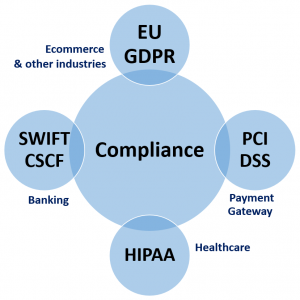
  • Regulatory Compliances: Regulatory compliances like EU GDPR, PCI DSS, HIPAA, ISO etc. help organizations to keep their data safe from breaches. The compliance bodies are extremely stringent on the norms and policies and expect organizations to abide by the standard regulations. Any kind of non-compliance costs hefty penalties to the organizations and eventually suffers a business setback.


Conclusion

Any organization desires to have a smooth, growing and uninterrupted business journey – just like a pleasant and safe long drive. All the necessary IT security measures once taken and relevant solutions adopted, an organization ensures a safe business journey.  

Role of PAM in Securing Financial Data Assets

Overview


Can we afford to lose the master key of our bank locker? We are always over-cautious about the security of our financial assets. Similarly, in the digitalization era, we are controlling our virtual money through mobile banking, internet banking, UPI and more. The changing consumer behaviour has forced the financial institutions to overhaul their IT infrastructure.  

In the digital era, modern financial institutions must adopt innovative IT mechanisms and security in order to ward off data threats. More importantly, access to Privileged accounts, gateway to confidential information, must be robust to mitigate malicious insider activities and anomalous third-party threats. 


Why are Financial Institutions targeted?

Financial institutions like banks, insurance companies, mortgage companies among other financial entities are prone to data breaches. There is a continuous threat to this sector such as financial losses arising from breaches, regulatory penalties along with damage to reputation.

The IT infrastructure vastness and the extent of data sensitivity of this industry have always lured cyber criminals to target this industry for years. 

Financial institutions process, store, and transfer business-critical information and private customer records every day and every hour. This huge and endless process of data accumulation keeps organizations piling on their ‘responsibility to protect data’ every single day. Once compromised, these PII (Personally Identifiable Information) claims a comparatively higher price on the dark web. Thus, this industry is more susceptible to breaches.


What are the consequences?

A couple of years back, an Indian nationalized bank suffered an embarrassing IT security breach where the hackers siphoned off almost Rs. 95 crore. The organization has overcome the loss gradually, but the scar of being in the news for the wrong reasons never fades away. Once organizations face such a cyber catastrophe, the victim might face years of:

  • Financial Stress 
  • Legal Liabilities
  • Compliance Penalties
  • Faceloss/ Reputation loss
  • Fear of disloyalty from customers
  • No more proactive investors
  • Stakeholders lack of trust
  • Longer revamp of IT security policies


Why is it a challenge for financial institutions?

Our research suggests that cyber attacks against the financial sector increased almost 250% globally between the last two years, with some 80% of financial institutions reporting an increase in cyberattacks during the pandemic. Hence, the severity of cyber vulnerability in the financial sector is quite alarming. There are several reasons behind these whooping figures, but the major among them are

  1. More Third-party Service Providers – With the increasing business operations, the IT expansion goes without control and organizations face the challenge of monitoring and controlling all end-users in the network periphery. 
  2. Adoption of Cloud Infrastructure – Financial organizations are migrating their data centers and overall IT infrastructure on the IaaS platform for more convenience. However, it invites complex security challenges to ponder over.
  3. Lack of Control of Privileged Identities – Too many privilege elevations pose higher risk in a vast IT ecosystem. It results in lack of control and monitoring of the privileged tasks and eventually invites cyber anomalies.
  4. Equal Importance to all Regulatory Compliances – Multiple global regulatory standards help organizations to maintain end-to-end security in their IT infrastructure, though many times organizations fail to follow the mandates and invite non-compliance penalties.
  5. Lack of Zero Trust Security framework – With the advent of both remote and on-prem work conditions, financial institutions need to have Zero Trust security policy to ensure every access to the critical applications/ systems is verified and tested. Without this framework, proactive security control is not possible.


So, how can we overcome the challenges? What is the solution?


Privileged Access Management (PAM) solution is the best bet

A robust Privilege Access Management solution as ARCON | PAM secures all privileged accounts of financial organizations and helps to protect the information assets proactively. The seamless controlling and monitoring of every privileged access happening in the servers at a granular level limits the moves of a cyber criminal and lowers the chances of security breach. 

The solution offers a centralized engine to govern privileged users where role and rule-based authorization policy, controls and monitors privileged users. 

For IT efficiencies, financial organizations adopt cloud services, although the risks also multiply. ARCON | PAM offers adequate and relevant safeguards when it comes to securing financial assets on the cloud and even on hybrid cloud. The solution creates a robust security shield around privileged accounts in the IaaS environment to prevent illegitimate access and prevent data breach incidents. It reinforces stringent IT security controls by providing a digital password vault, adaptive authentication and dashboard for cloud identity governance. 

In order to manage all the privileged accounts in a financial institution, role and rule-base access is a must. The primary threat always comes from compromised insiders. If business critical applications are accessed without role and rule-based privileges, just-in-time privilege elevation, and revoking privileges after the task is over, then obviously a malicious insider can misuse or abuse sensitive information and wreak havoc. ARCON PAM offers all critical capabilities such as Just-in-time Privileges to target systems, Privileged Elevation and Delegation Management (PEDM), and Granular controls to ensure access is limited and only on ‘need-to-know’ and ‘need-to-do’ basis. 

Financial institutions have to stay compliant to multiple global regulatory standards like EU GDPR, PCI DSS, SWIFT CSCF. As a result, it is always wise to deploy a reliable Privileged Access Management (PAM) solution that helps the organizations to follow the mandates by default and evade chances of any non-compliance penalties.

Lastly, Zero Trust Network Access (ZTNA) has become the benchmark of a robust security infrastructure in modern enterprises. Financial organizations worldwide are facing increased demand for virtual modes of money management. Most of them are striving to ensure seamless and secure remote access across their IT environment, ARCON | PAM offers best security assurance to the risk assessment team by enabling the ZTNA security framework in the overall IT ecosystem.


Conclusion

Today, IT security teams of the financial sector demand solutions that are more proactive rather than reactive. ARCON | Privileged Access Management (PAM) solution offers a proactive approach to secure privileged access to target systems.