Talk to us Risks to Watch

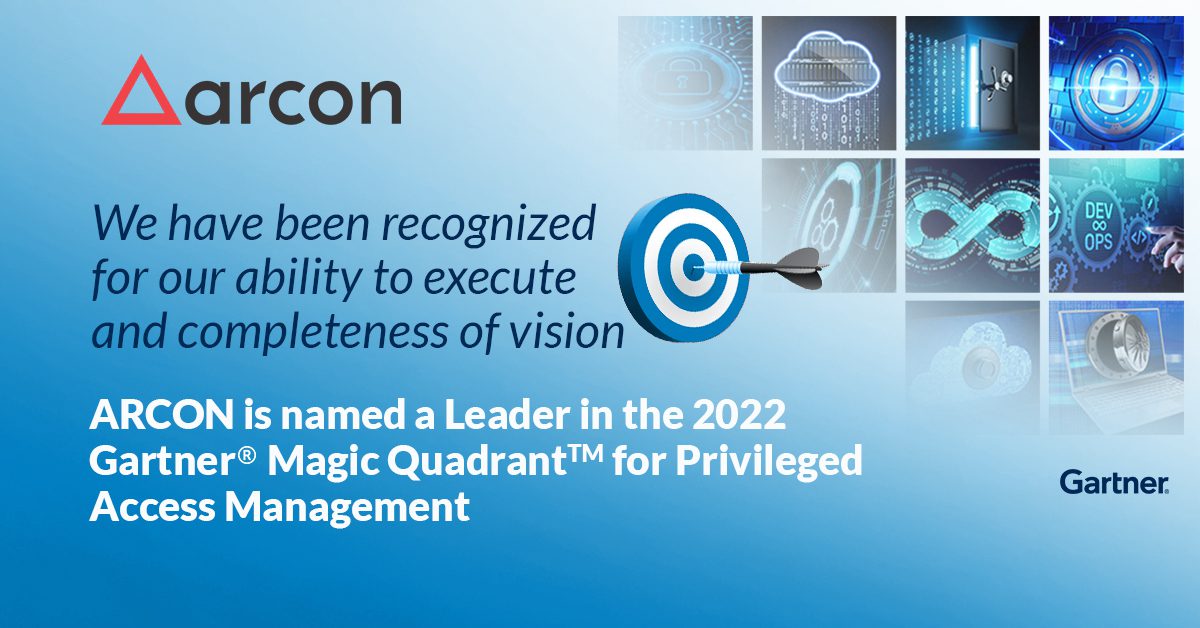
2022 Gartner® Magic Quadrant™ for Privileged Access Management

ARCON is proud to announce that, for the second year in a row, Gartner has named us a Leader in the Magic Quadrant for Privileged Access Management. In the 2022 Gartner Magic Quadrant for Privileged Access Management report, released in July 2022, ARCON has been recognized for its ability to execute and completeness of vision. 

So congratulations to our entire team for their hard work and perseverance—and, of course, to the management for their foresight and guidance.

And a big thank you to our global partners and customers as well. Your unwavering support keeps ARCON motivated as it continues to challenge every boundary.

Why we think is the Gartner Magic Quadrant so important?

A Gartner Magic Quadrant is a culmination of research in a specific market, giving you a wide-angle view of the relative positions of the market’s competitors. By applying a graphical treatment and a uniform set of evaluation criteria, a Magic Quadrant helps you quickly ascertain how well technology providers are executing their stated visions and how well they are performing against Gartner’s market view.

The Report: Gartner Magic Quadrant for Privileged Access Management

We believe that the 2022 Gartner Magic Quadrant for Privileged Access Management is a comprehensive report to evaluate global Privileged Access Management providers. Please read this report to find out more about ARCON’s strengths and capabilities.

Disclaimer: Gartner and Magic Quadrant are registered trademarks of Gartner, Inc. and/or its affiliates in the U.S. and internationally and are used her Gartner does not endorse any vendor, product or service depicted in its research publications, and does not advise technology users to select only those vendors with the highest ratings or other designation. Gartner research publications consist of the opinions of Gartner’s research organization and should not be construed as statements of fact. Gartner disclaims all warranties, expressed or implied, with respect to this research, including any warranties of merchantability or fitness for a particular purpose.ein with permission. All rights reserved.

Why is Cyber Insurance of Paramount Importance?

The Context

Having risk preventive measures in place is better than reacting to cyber threats. The former approach enables organizations to build a robust IT infrastructure through a layered approach, building security shields at every level, such as network, devices, data, and users. 

Nevertheless, cyber criminals are too sophisticated today and possess an uncanny ability to inflict damage by exploiting the security gaps at any point. That’s why cyber insurance is becoming important for today’s organizations.

Cyber Insurance is no longer an option, it is now mandatory. The adoption of sophisticated technologies for seamless IT operations has made organizations vulnerable to complex IT threats. Hence, the importance of cyber insurance is mounting.

In the past few years, data breach incidents have led to huge penalties and financial losses for organizations since regulatory compliance has been extremely stringent. In almost every industry, we find that large and mid-scale organizations have faced big financial penalties for non-compliance or sometimes loopholes in the compliance standards. That is why demand for cyber insurance has been at an all-time high in the last couple of years. 

The Reasons Behind Urgent Need to Have Cyber Insurance 

Proliferation of Data: The total volume of data generated, captured, copied, and accumulated globally till 2020 is 64.2 zettabytes (as per our market research). Global data volume is expected to reach 180 zettabytes by 2025.In spite of the COVID-19 pandemic, the research analysts strongly anticipate that it might grow more than the figure mentioned as digitalization has been adopted by every industry. 

Many people have worked remotely in the last couple of years, and organizations adopted new data storage methodologies to manage data. Cloud storage is the most obvious of them all. Since 2020, adoption of cloud computing and the shifting of IT operations to cloud environments has grown by 36% annually. 

With a significant amount of data generated across applications and amid an increasing number of users spread across multiple cloud platforms and hybrid data center environments, the challenge of protecting the data has increased. 

Increasing Attacks on Business-Critical Data: As the volume of data generated is growing, the security of that data has become highly critical. According to a report by The Economic Times, there were nearly 8.7 crore data breach incidents across the world in 2021. 

Malicious insiders and suspicious third-party users are the major reasons behind the increase in data breaches worldwide. Many insiders, especially users with elevated rights to applications, databases, and other forms of sensitive information, are typically aware of what and where the critical data is generated and stored. 

The threats have increased in hybrid work conditions, and it takes a lot of time to realize and identify that a data breach has occurred. 

According to Forbes, 49% of organizations agreed that it takes an average of one week to identify insider attacks, which worsens the situation. At the same time, third-party users, especially managed service providers (MSPs), software (or other equipment) vendors or business consultants, have increased alarmingly. Organizations appoint them for ease of work and allow them to access many sensitive data assets. As a result, confidential business data gets compromised.With the uncontrolled growth of data, the concern for data security is also intensifying among IT security leaders. 

Stringent Global Compliance Framework: Regulatory compliance (both global and regional) is getting increasingly stringent. While non-compliance with regulations, in the case of a breach, leads to massive financial losses, any organization that is not compliant with the global information security standards such as the GDPR, RBI Guidelines, NIST, FedRAMP, SOC2, PCI-DSS, HIPAA, SOX, etc., then there are chances that the cyber insurer might reject the organization’s insurance coverage application. 

Analysis & Recommendation: Cyber insurance covers cyber risks with a highly competitive monetary margin. In the case of massive data breaches, organizations might not always have adequate resources or finances to recuperate the losses. That is when cyber insurance is required as it can offer all the financial support and does not allow any kind of disruption in the business process. 

However, at the same time, if organizations are lackadaisical towards data protection and data security measures, then they might end up paying higher insurance premiums.  

ARCON recommends the deployment of robust Privileged Access Management (PAM) and Identity Access Management (IDAM) solutions to address the data security challenges mentioned earlier. These solutions not only strengthen cyber defense but also help lower premiums by assisting in compliance with a variety of IT regulations. Some of the benefits include: 

  • Ensuring authorized access to the critical systems and data assets
  • Seamlessly monitoring of privileged sessions to ensure that there are no anomalies around the confidential business data
  • Implementation of the  ‘Least Privilege’ principle and reinforces the Just-In-Time privilege solution
  • Ensuring flexibility and scalability in on-prem, remote and IaaS/ PaaS/ SaaS infrastructure
  • Building the foundation for the ‘Zero Trust’ network security (ZTNA) framework

Conclusion

The proliferation of data and data security threats in every industry has increased the importance of cyber insurance. ARCON adds value to organizations by reinforcing best IT security practices with the help of its robust information security solutions. 

Why is Privileged Access Management (PAM) Critical for Telecom Service Providers?

Overview

Telecommunication service providers are one of the fastest growing industries worldwide. Every telecom service provider today offers 4G/5G wireless services, mobile commerce, and high-speed broadband, which have become almost necessities in the daily lives of netizens. At the same time, they are always trying to upgrade their services to ensure that the customers get an uninterrupted communication experience.

As customer expectations mount, telecom service providers are continuously trying to add more value to their services to ensure a seamless experience of voice calls, messaging, and email communication. In order to control and manage huge requirements, telcos IT ecosystem lands in large and distributed environments. 

Today’s telecom organizations invariably have a large number of privileged identities spread across disparate networks and technologies. Safeguarding these identities in a highly critical core telecommunications environment is imperative for the ongoing success and growth of the industry. 

Telecom Industry: The Urgent Need to Reinforce the Privileged Access Management Practice 

Organizations from the Telecom industry tend to have large IT operational infrastructure and hence the threat surface is quite expanded. To ensure uninterrupted daily operations, the organizations need to ensure that their privileged access environment is safe from any kind of anomalies. As the number of privileged identities increases, the access control risks also intensifies. Let us see the areas from where telecoms majorly face IT threats: 

Third-party access and services: The technology and operational landscape in the telecommunications service industry are transforming drastically due to constant demand for better services. As organizations offer a host of value-added services, the core telecom network remains responsible for the security of all sorts of data records. 

But to meet the operational requirements, telcos invariably outsource backend tasks to third-party service providers. And these outsourced parties are always vulnerable to data breaches as they manage huge volumes of customers’ data. This makes them a high priority target for cybercriminals. 

Moreover, third-party software vendors/consultants, Managed Service Providers (MSPs), Original Equipment Manufacturers (OEMs) are also among other third-party providers. As a result, access control policies and user authentication mechanisms need to be continuously assessed, verified and managed to ensure whoever is accessing the critical systems is authorized and has a genuine purpose behind the task. 

Whether working remotely or on-prem, organizations need to have a well-defined access control policy for every user. Without a fine-grained access policy, the IT security team could be in the dark about who is accessing what and for what reason. Eventually, this could disrupt security controls even in the deepest layers of the network. 

Compliance Standards: In the telecom industry, every service provider has to meet a stringent set of security controls and standards. Identity and Access Management (IAM/IDAM) which includes Privileged Access Management, is one of the key areas where the service provider has to ensure compliance. 

These practices ensure that the requirements such as managing the life cycle for privileged identities can be broadly summarized around access methodologies, including adherence to other mandates like role-based access control, detailed logs, shared accounts, and password controls for hundreds of thousands of devices. 

Identity Theft: Identity theft is definitely a severe concern among the mobile telecommunication service providers. As per a recent report, the telecom industry’s identity fraud rate has increased by 50% since 2017. The fraudsters stealthily hack the telecommunication system or clone the system pattern to abuse legitimate organizations for frauds and possess criminal gain.

How Privileged Access Management (PAM) solution thwarts the threats

ARCON | Privileged Access Management (PAM) solution offers comprehensive preventive measures to the above challenges faced by telecom organizations.

  • ARCON | PAM integrates all the elements under a single command and controls every access happening in the systems seamlessly. Any user accessing any system or device at any point of time is authorized and authenticated and thus secures the access.
  • ARCON | PAM manages and controls every access on “Need-to-Know” and “Need-to-do” basis which is why a comprehensive workflow is maintained to grant access to the critical systems and devices.
  • ARCON | PAM offers remote access control that prevents any unauthorized or unrecognized access to the critical telecom systems and offers secure access to the data centers of multiple locations without any requirement of extra servers.
  • ARCON | PAM offers a centralized access control policy for all the privileged users and secures the privileged access environment with a password vault engine that automatically generates passwords and rotates them for different devices managed by the solution. These passwords are vaulted by the system and are not visible to the end-users.
  • All the session logs of the administrative activities are monitored and recorded by ARCON | PAM in text and video format to verify and identify any suspicious activity in the network; these texts and videos are tracked centrally for more security and are not available to the end-users.
  • Lastly, ARCON | PAM helps to comply with the standard regulatory requirements – both global and regional. 

Conclusion

The use case challenges are increasing in the telecommunications industry. ARCON | PAM

with its highly scalable API-based architecture helps the global telcos to safeguard the core telecom infrastructure to ensure data privacy, confidentiality and integrity.