Talk to us Risks to Watch

Endpoint Security as a Data Protection Tool: Essential or Unnecessary?

Endpoint security, in essence, is the regimen of restraining any form of internal access in an organizational endpoint infrastructure. As the name implies, the discipline is primarily implemented upon end-user devices, such as laptops, desktops, and smartphones.

But, how does it work in a professional environment?

The endpoints are usually utilized as an entrée to any network and create different points of entry. An individual with malicious intent can exploit them to gain critical information from an organization and wreak havoc on their reputation.

An endpoint security tool protects such entry points through encryptions and prevents malware programs from accessing delicate details. By ensuring endpoint compliance with your data security structure, you can gain superior control over everything.


Why Should You Worry About Your Endpoint Devices?

In today’s digitized world, almost everyone uses either a smartphone or a laptop. As per a report, 6.4 million people are using mobile in 2021 (a 5.3% increase since 2020). However, the worrying part is that each of them has an entry point.

Thus, it becomes easier for hackers to exploit the severe lack of security and extract personal information from an endpoint device. Endpoint attacks are reasonably prevalent as well. In 2020, the number of such cyber-threat increased by almost 68% than the previous year.

So, if you have any vital information on your devices, they may get stolen at any time. However, an endpoint security system can put an end to such worrisome circumstances.

An endpoint security infrastructure is built on two aspects – detecting a suspicious end-user and preventing unauthorized access.

With it, you can not only control your endpoint access but also monitor malicious activities on your network. You may block a user of the same device if you feel they are attempting to input malware into your endpoint devices.

The endpoint devices of an organization (or an individual) are considered the weakest link in the networking cosmos. Therefore, ensuring its safety and security will be beneficial in a long-term scenario.
 

Integral Features of Endpoint Security

As per RiskIQ, organizations all over the world experience more than 350 cyber-threats every minute. Hence, if you want to make your network, make sure to opt for an endpoint security tool with the following features.

  • An endpoint security tool must be capable of detecting a malicious e-mail and terminate it instantly. This way, the commonality of phishing can be countered efficiently.
  • It should protect against zero-day (a type of difficult-to-identify flaw found in software during development) and any other further exploits.
  • The system needs to offer alerts when something malicious enters your endpoint infrastructure. Besides, it must provide a daily report with regards to questionable activities as well.
  • An endpoint security system can also scrutinize the outgoing and incoming traffic of your network system. Conjunctively, it must offer browser protection to save you from downloading something malicious.
  • It needs to have a DLP system integrated into it as well. This way, the software program can access violations caused by your employees and prevent unintentional/intentional data loss.
  • Availing endpoint security with implemented machine learning can analyzing good/bad files much more manageable. It may also help the module to block malware variants before they can damage your endpoint devices. Machine learning may also help in monitoring your employee’s behavior and find the culprit beforehand.
  • An endpoint security system should be flexible to be deployed as per the organization’s requirements. Finding a tool, which offers both cloud and on-premise security, will be ideal for any corporation.
  • Finally, the software programs need to be integration-friendly as well. This way, it will be easier for the system to communicate with the other security tools in your organization. Through proper incorporation, endpoint security can also prevent intrusion, create an active directory, and monitor your network.


Endpoint Security and Other Cybersecurity Systems

An endpoint security system can only do so much in a vast network environment. Therefore, you need to pair it up with at least one or two other protective infrastructures to maximize its potential. Let’s learn more in this regard through examples.


Endpoint Security and UBA (User Behavior Analytics)

In some cases, the threat of exploiting the weakness of your endpoint devices is caused by your end-users. Hence, if you know about those individuals who conduct suspicious activities, you can avert the worst conclusion efficiently.

However, the catch is that an endpoint security system alone cannot perceive user behavior entirely. So, you will need to use a UBA tool to maximize its efficiency in this respect. Here’s how User Behavior Analytics can be ideal for your cause –

o   Allows you to perform data profiling and detecting anomalies

o   Collects insights on the malicious IT profiles (can be implemented on the endpoint security system to block them before any demurrage)

o   Offers superior analytics capabilities and quicker risk detection

o   Lowers the risk of data abuse or misuse in an organizational environment
 

Endpoint Security and EPM (Endpoint Privilege Management)

Using EPM with a dedicated endpoint security system will improve the latter’s performance in several aspects. For instance, it can help in increasing the overall security efficiency during a privileged task. This way, you won’t be bothered with malware programs that may cause hindrance to your work.

Additionally, it will be easier for you to create a role-based access infrastructure in your organization. By doing so, you may not have to create unique profiling for all of your employees. Finally, you can also use the dashboard of EPM conjunctively with endpoint security to get a real-time view of the privileged sessions.


Conclusion

In truth, adding an endpoint security system alongside other cybersecurity programs might not seem like a cost-effective decision at first. However, it can save you from data theft and severe network breakdown, which may cost you even more. So, a business should implement and integrate a dedicated endpoint security tool in their organization’s infrastructure.
Role of IT Security in Business Alliances

Overview

Business alliances and partnerships are key growth enablers for both large organizations and SMBs. The main purpose of a business alliance is to achieve the desired financial goals by sharing operational responsibilities that are mutually and easily doable. 

Many organizations even go for alliances to fulfill the gaps in their business process with the help of their partners. It not only brings efficiency gains but also boosts profitability. 

Now, to make a collaboration that brings the desired results, secure IT infrastructure plays a pivotal role. A single IT security loophole or a cyber incident cannot only affect the victim but also the alliance partner who is involved in the business collaboration with the victim. In other words, in addition to business synergies, both parties need to understand the significance of IT security measures being implemented in place. 

Why is IT security crucial in business alliances?

Although business agreements between two organizations cover the scope, objectives, requirements, and profit sharing details, crystal clear policies on data security and IT governance framework must be part of any partnership agreement.

Every organization desires a secured IT infrastructure today to ensure an uninterrupted business process. With the rising complexities of cyber security, it is highly imperative to keep in  mind the IT infra security requirements of both merging businesses for a smooth transition.  

A single breach incident cannot only cost heavily to both partnering organizations, but other business stakeholders and investors will distrust the company if they find that the data is not managed properly. 

For any partnership to prosper in today’s digital landscape, the partnering organizations have to be at par with global standards. It should start with establishing stringent IT security policies and standards. IT governance is critical to ensure sustainable business growth. 


What are the apparent IT risks?

As business-critical data flows from system to system and is shared and accessed by multiple end-users, what would happen if it lands in the hands of any suspicious third-party user or any malicious insider? What if there is cyber espionage or data exfiltration?

The answer to all these questions boils down to one and only way out:Strengthen IT security policy and mechanisms to ensure business continuity. 

For instance, a manufacturing company with large on-prem IT infrastructure collaborates for business synergies with another company with strong supply chain capabilities that has installed multiple SaaS applications.

That means, once merged, the new entity will have large hybrid IT environments, exposing it to more IT and data vulnerability. 

If the new business collaboration fails to establish robust IT governance and policies to manage and monitor end-users in hybrid environments, the threat to systems will amplify. 

Besides, suffering heavy financial losses stemming from the data breach, today’s organizations have to face a double whammy: massive financial penalties arising due to non-compliance. Adding to the woes is the loss of reputation. 


Business Alliances: Some Measures for Data Security 

Unified IT governance: Organizations do require a unified IT governance framework for better visibility. A centralized governance approach ensures authorization and audit of every IT activity even as data flows endlessly within the organization. Unified IT governance enhances end-points’ security and secures identities that continually interact with business-critical applications.

Robust Access Control: It is always advisable to have a tight access control in any IT environment. Both for on-cloud and on-prem IT infrastructure, a robust access control mechanism with multiple layers of user authentication validates the end-user. Especially for organizations where a large number of privileged users regularly access business-critical applications and systems, it is highly imperative. Moreover, when two organizations merge, role and rule-based access control helps both the organizations to segregate the users in task-based groups, which again is more secure from an IT risk perspective.

Regulatory Compliance: By building security controls that adhere to regulatory mandates, organizations can mitigate data breaches and avoid paying hefty fines for non-compliance. Several global regulations such as the EU-GDPR and IT Standards like the PCI-DSS, HIPAA, ISO 27001 etc. among many regional and Central Banks mandates explicitly mention the need to reinforce the Access Controls, Access Management, Password Rotations, Segregation of end-users based on responsibilities and frequent IT audits and reporting. 


Conclusion

Robust IT security must be at the core of any business alliance. Poor IT security planning or an IT incident will only result in higher cyber insurance premiums and eventually impact the profitability and sustainable growth – the purpose for which entities forge alliances. 

Single Sign-On Explained: How SSO Improves Security And User Experience?

Creating a diverse set of login credentials for each app you use on your smartphone or laptop can be challenging. This is most common in the workplaces where the employer accesses diverse employees daily during different hours. But this can directly take a toll on your overall device security as well. Fortunately, we can address this challenge without any compromise. 

ARCON avails a hands-down single sign-on system that allows you to log into multiple applications using a single login credential. When the user logs in via SSO on their device for the first time, the SSO authenticates the user once. As soon as the SSO shows the login process, it is then translated, and the authentication parameters are stored successfully. So, the next time you try to log in to the systems, SSO will share the credentials and make the process a seamless experience. This is done as per the authentication mechanism that the application supports. 


Let us take a closer look! 


What is SSO?

ARCON SSO is an access management capability analyzer that comes with remembering one credential. So, no matter how many platforms you use on your phone, logging into all of them becomes as easy as it gets. Now, you do not have to worry about creating different passwords and IDs for all. So, it is even better to manage security and user experience. 

With SSO, you can log into it using one credential, as discussed above. So, when you are logged in, every application will be available to see on the portal systematically for you. Conclusively, it helps to reduce the risks of misuse of any application to a considerable extent. Here are some critical features of ARCON SSO that give a deeper insight. 


Key Features That Promote Security and User Experience

1. Password Management 

Password management is an integral method to ensure Security and prevent service disruptions. So, when you are configuring the application solutions, it is wise to set a complex password. This will reduce the chances of hacking or phishing on your device to a considerable extent. One can update the password either manually or rotate as per the defined policy. With this at hand, you will be able to encourage comprehensive synchronization that can occur in almost all networks around you. 

2. Self Service Portal 

If the user has not been allotted a specific application, they may raise a request for it. The entire idea of a self-service portal is based around it. So, once the request is approved, the application will become a part of the already-existing portal in no time. 

3. Seamless Integration 

Using the internet and its widespread features comes with an added risk of security all the time. As such, it becomes integral to mitigate them at every step of the way. ARCON SSO allows seamless integrations using app web browsers that foster security and reduce the risks exponentially. This process also improves the visibility of the user. As such, the SSO can be used for browser applications without enough hassle. 

4. Access Control 

Unauthorized changes in your device can raise concerns at times. Since it may question your overall device security, it is best to abstain from it as far as possible. Access Control encourages this initiative. This is a critical security feature that wards off any unauthorized changes that occur on your device. So, it helps manage the entire access system by enabling the user login time, disabling it and even disabling or enabling the dual authentication factor in need.

5. Robotic Process Automation (RPA)

 Automation is the need of the hour. It improves a seamless experience and paves the way for accuracy and efficiency in no time. This is the process that helps automate the usual tasks people perform. As such, the user can work at ease for as long as they want and encourage a strong user experience. This also helps foster productivity as it is less time and energy-consuming. In turn, people can focus on more critical tasks at once. What is most intriguing about using this facility is that you can personalize your steps for any SSO activity you perform using this feature.

6. Multi-factor Authentication 

Well-defined identity references can play a pivotal role in accessing a range of apps. Every user access demands this at all times. When you use Arcon’s multi-factor authentication, you can avail yourself of its sound validation mechanism too. It can be highly secure for you in the long run. 

7. Just-In-Time Access 

If you want to utilize time-based access, this app can come in handy for you. It can be helpful for all types of users, whether customer or third-party vendors. As soon as the time that was allocated to the user is up, each right and access is revoked. So, no manual intervention is involved in this process. 

8. User Provisioning and Deprovisioning 

Arcon’s SSO does not just offer the usual provision and deprovision functions. It may also come in handy for provisioning and deprovisioning from within the apps too. As such, you can control this more comprehensively.


ARCON | SSO for seamless cloud-first journey

Download the whitepaper


How does SSO offer a Sound User Experience?

Once ARCON SSO is deployed, you are likely to get your hands on many potential benefits that will offer credibility and scalability like never before. Take a look below. 

1. Less Time Consumption

As the login credentials of ARCON SSO provide unique features like robotic process automation, the process becomes less time-consuming. Also, all the applications can be logged into using a single credential to complete this process before time. 

2. Promotes Security

The stronger your password, the better security your device can offer. ARCON SSO offers paramount Security that makes sure the user remains safe every step of the way. So, the ability to generate strong passwords becomes possible with this technology at hand. 

3. Ease Of Operation 

We have already discussed how this SSO helps you to use a single credential for all types of applications. As such, it not only helps save ample time but also eases your daily operation to provide a seamless experience in need. 

4. Toggle Functionality 

Sometimes the organization may be using SSO, while other times, they may switch to PAM. As such, you must be prepared to make the switch between both worlds as and when required. With ARCON SSO, this becomes a cakewalk. 

5. Speedy Functions 

Speed functions can instantly amp up your productivity at work. As such, Arcon’s SSO can be your best friend. Enjoy real-time speed functions as it promotes rapid development and releases cycles for your convenience. 


The Bottom Line 

ARCON offers best-in-class SSO to ease your login processes. With this, it is not just easy, efficient and flexible but also a highly secure process to scout for. So, why keep waiting? Make the most of ARCON SSO to improve your user experience and credential system forever. Get started today!

Top 5 Overlooked IT Security Threats

Overview


How much time does it take to place an online order for your lunch or dinner? 1 minute or maybe a few seconds more! Statistics show that in a single hour 90 cyber hacks and data breaches are happening across the globe. It means that by the time we order our lunch, a security breach occurs!


The IT security patterns have evolved a lot since remote work conditions became effective. Furthermore, while we gear up for the back-to-office, the cyber threat patterns are also changing drastically. Generally, enterprises understand and emphasize the common and most-discussed IT security threats. However, some threat areas prevail within the IT infrastructure that we tend to overlook quite often. 


Here are some top threats that we need to keep in mind to ensure information security.


  • Data Mobilization 

If organizations lack stringent data security policies, then the growing mobilization of data leaves them vulnerable to breaches. Undereducated or lackadaisical employees could unknowingly leak the most confidential business data to the malefactors.

Risks aggravate if adequate configuration management is not done to ensure that end-users store data in the right place. If it is a cloud environment, the risk is even more as organized hacking groups are more expert at exploiting access control vulnerabilities. Not only corporate data is at risk, business-critical applications and corporate social media accounts, every data is flowing uncontrollably. In this backdrop, if corporate and business-critical data is not segregated properly, especially in WFH conditions, then a single breach could be catastrophic. 


  • Cyber Espionage

This hi-tech spying started way back in the late twentieth century. Even a couple of years ago, a 12-year cyber-espionage was discovered where hackers were eavesdropping on different government agencies and firms of other nations to sabotage their regular IT operations for an indefinite period.

To delve deeper into the concern, even today, enterprises are quite oblivious to the spying of confidential business secrets. Large corporations and government organizations are prime victims of cyber espionage, majorly done by rivals. The information stolen through spear phishing or malvertising are sold to some higher bidder or to the dark web. If cyber espionage is not taken seriously on time, it can put business processes and progress at stake.


  • Poor Data Encryption

Data breaches are costly if organizations fail to deploy standard encryption tools. Most of the organizations have mastered data encryption in transit but are unable to secure it at rest. This leaves data vulnerable and lowers the restrictions for cybercriminals to pack a punch. It is seen that organizations store encryption keys on the same system where data is stored. It is indirectly keeping the keys just beside the lock. Open access to data by end-users of different roles means IT security is ‘always unlocked’!


  • Updates of Security Patches

Cyber attackers obtain illegal access to the enterprise IT infrastructure because of IT loopholes. Unpatched software is the easiest and most frequented entry door to critical systems. Organizations with information security solutions always identify the patches that are not updated and act immediately. Not updating security patches is an open invitation for the cyber criminals to use the loopholes and abuse data.


  • Asset Management

Without a complete inventory of IT assets, it is never possible for any organization to keep a track of unmanaged and unprotected systems/ networks. If an organization is not aware of a system which is left unsecured, then security breaches are inevitable. The essence of asset management tools is for tracking and assessing software and hardware components to protect the IT environment from possible IT security threats.


Conclusion

Security is actually a peoples’ problem, not a technology problem. The majority of breach incidents are enforced by an undereducated employee who makes security mistakes while performing their routine tasks. These hack incidents could have surely been avoided if they were trained properly. Many times, employees share their credentials with their colleagues or managers when they are out of the office, so that any urgent assignment is not kept on hold.

In every circumstance, organizations need to have defined security policies to ensure accountability from the employees as they are the first line of defense. They should be equipped with relevant security awareness so that they can identify any suspicious activity and take preventive steps before the breach occurs.

Least Privilege Approach – Why is it required for Network Security System?

The concept of the Least Privilege has been around since the 1900s. Hence, a cybersecurity enthusiast is probably already acquainted with it. However, most people usually have a bleak idea about the facet of Least Privilege Principle and the benefits of the Least Privilege Approach. Let’s read.


What is the Principle of Least Privilege?

To begin with the term “Principle of least privilege” or “Least Privilege Approach” convey a similar meaning. Thus, we might use either of them while going on about the topic.

It is the notion of information security, which offers a minimum level of access to a user. While working in such an environment, you will need to seek access permissions quite frequently. It is necessary to keep your network system away from the risk of phishing.

Like any other multifarious segment of cybersecurity, Least Privilege principle too, accompanies several foundational principles. The most notable amongst them are – integrity, confidentiality, and availability.

Therefore, you can implement it on both network systems as well as connected devices. This way, you can prevent the non-human applications from availing anything more than the requisite access.


Background of the Principle of Least Privilege

The background of Least Privilege Principle is somewhat unknown and obscure. However, the notion came to life during the 1970s with Jerome Saltzer, an American Computer Scientist. Later, Peter J. Denning offered a broader insight on the topic in his research paper.

Historically, the earliest touch of this principle was found in the Login C source code. It used to have a set of super-user permissions, which the system administrator could only access. Once they became unnecessary, the system dismissed them through a non-zero argument.


Privileged Elevation and Delegation Management (PEDM)

Watch All videos


How to Implement?

There have been several reports conducted on the subject of least privilege. Hence, the usage of the same has also changed quite methodically over the years. Currently, most organizations are implementing and using this system through the following methods –

  • Location-based Access: The location-based access setting is pretty specific, as it can bound your employee to use a critical system from a particular location. For instance, you may use it on your organization’s database so that no one can use it when they aren’t in the office.
  • Group-based Access: Managing user accesses for over a thousand employees can be somewhat tricky. However, this is where least privilege, or more specifically, an IAM tool, comes in. With this security program, you can offer user access based on an individual’s role or job. With this principle, it will be easier for you to remove someone’s accessing ability when they leave your organization.
  • As-Needed Access: An organization may need specific data almost anytime. Nonetheless, if you have set up your least privilege principle manually, then accessing it would be troublesome. So, to avoid such issues, you will need to elevate your company’s privileges on an as-needed basis. This way, it will be easier for you to revert to the standard accounts without suffering any consequences.
  • Machine-based Access: Most companies use this system as an alternative to location-based access. With it, you can make it possible for some selected machines to get all the classified information. If someone uses any other computer to perform the same task, they won’t find anything.

Lastly, you can also create single-use accessible accounts with the Least Privilege Approach. It is a much safer option, as you can use the passcode only a single time to access the data you need. If anyone wants to get the same information again, they will need to ask the administrator about a new password again.

What are the Benefits of the Least Privilege Approach?

Since the last decade, the prominence of cybercrime has increased massively. According to a report, almost 88% of organizations in the world have already experienced phishing attempts. Hence, using a single tool to bolster your system would not be enough. In addition to it, you will also need to implement at least one least privilege-based program. Here are the benefits you may get if you do so –

  • With the Least Privilege Approach, you can shut the access of critical databases or systems almost exclusively. Therefore, in a way, it can offer better security, especially against human errors and other phishing attempts.
  • If only a limited amount of people use a particular system, it will have a lower risk of attracting a malware program. Even if something malicious enters the environment, it will be contained in a specific area due to inaccessibility.
  • By limiting malware infestation on your system, you can make it almost invulnerable to sudden crashes. Therefore, the whole work system will be much more stable and efficient. It can be pretty advantageous for you if your company owns a large chain of network structures.
  • The principle of Least Privilege is usually implemented on an audited system. Therefore, the scope of performing an audit will minimize drastically for your organization. Moreover, you will not have to undergo various standard regulations if you use the Least Privilege Approach.
  • Finally, by removing local administrator rights from your system, you can also minimize the helpdesk calls effectively. Additionally, if you enable as-needed access, you can also increase the productiveness of the users.


Conclusion

As mentioned before, almost every information security system is complicated and multi-faceted. Hence, if you don’t have extensive knowledge about it, make sure not to implement it alone. The same goes for the Least Privilege Approach as well. So, if you wish to include it in your security system, be sure to ask an expert. They will offer the best possible security objective.

Endpoint Security Management: Some Hard Facts

Overview

In the backdrop of increasing digitalization, the number of endpoints are also increasing. 

And as the number of employees, working both remotely and on-prem, have started using their personal devices for work, it has been highly critical to ensure that each and every device in the workplace is secured from misuses. In the modern IT environment, more devices are inter-connected for different tasks at different levels in the network. As a result, it results in more avenues for cyber attacks. The need for endpoint security management comes here.

Why is it getting increasingly important?

Endpoint-security-management_Blog-1

Almost 81% of organizations revealed that endpoint security is the ‘most sought after’ security in complex IT infrastructure today. The increase of BYOD practice has made data access more fluid in almost all areas in the IT ecosystem. 

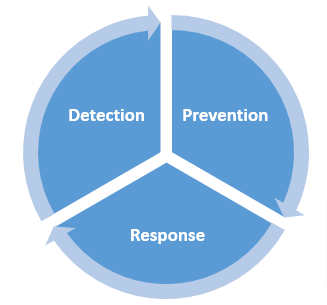
The endpoint security management is built up on the foundation of three pillars where unauthorized and suspicious end-users are detected and prevented from allowing access to the critical enterprise network base. Post-detection, the IT threat detection team receives notifications about the login attempts so that necessary security actions are taken before it’s too late. In this regard, very often, the benefits of Endpoint Security are mistaken with the benefits of Anti-virus software. Endpoint security approach in an organization makes endpoints more responsible for security whereas anti-virus software just secures the network.

Where are the risks?

According to Forbes, 70% of the most successful breaches originate at the endpoint. In the current Work From Home (WFH) scenario, most of the employees perform critical IT tasks through internal networks from endpoints without any restriction. As a result, the access control risks rise exponentially. Since endpoints ensure interconnection of every device in the network, the vulnerability of cyber threats in and around the endpoints increase alarmingly.

What are the accrued benefits of Endpoint Security Management? 

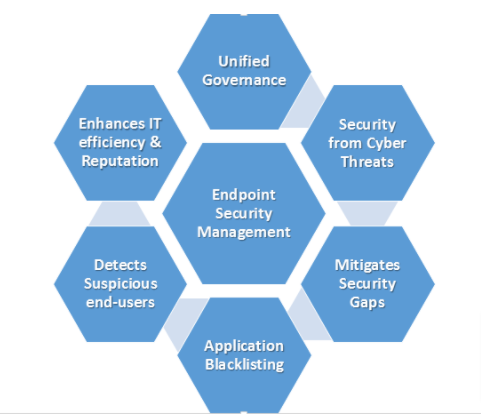
An endpoint security management can ensure a unified approach to manage and secure endpoint devices. From the administrators’ point of view, the organizations can reap the following benefits with the right solution deployed at the right time:

  1. Unified GovernanceA robust endpoint security builds the framework to govern end-users accessing critical devices. 
  2. Security against key cyber threats Once endpoints are protected from key cyber threats, the IT environment becomes safer and customer engagement improves. 
  3. Mitigate security gapsImproved visibility of endpoints on the network periphery, eradicates security gaps that could have been the reason for security breach incidents. 
  4. Application BlacklistingIt is extremely necessary to allow application access to the end-users based on daily use cases where the security mechanisms blacklist harmful or  useless applications in the network. 
  5. Detects suspicious end-usersA robust endpoint security detects suspicious end-users in real-time and prevents allowing access to critical applications.
  6. Enhances IT efficiency  – When endpoints are safe and secured from malefactors, the organizations can ensure an efficient IT environment 

Endpoint-security-management_Blog-Google-Docs

Conclusion

Managing devices both on-prem and remotely raises serious security concerns and questions. Endpoint governance and robust access control policies help organizations to get rid of the endpoint vulnerabilities. Hence, it is time to reinforce strong endpoint security management.